
Angkor Wat at sunrise, and the equinox alignment
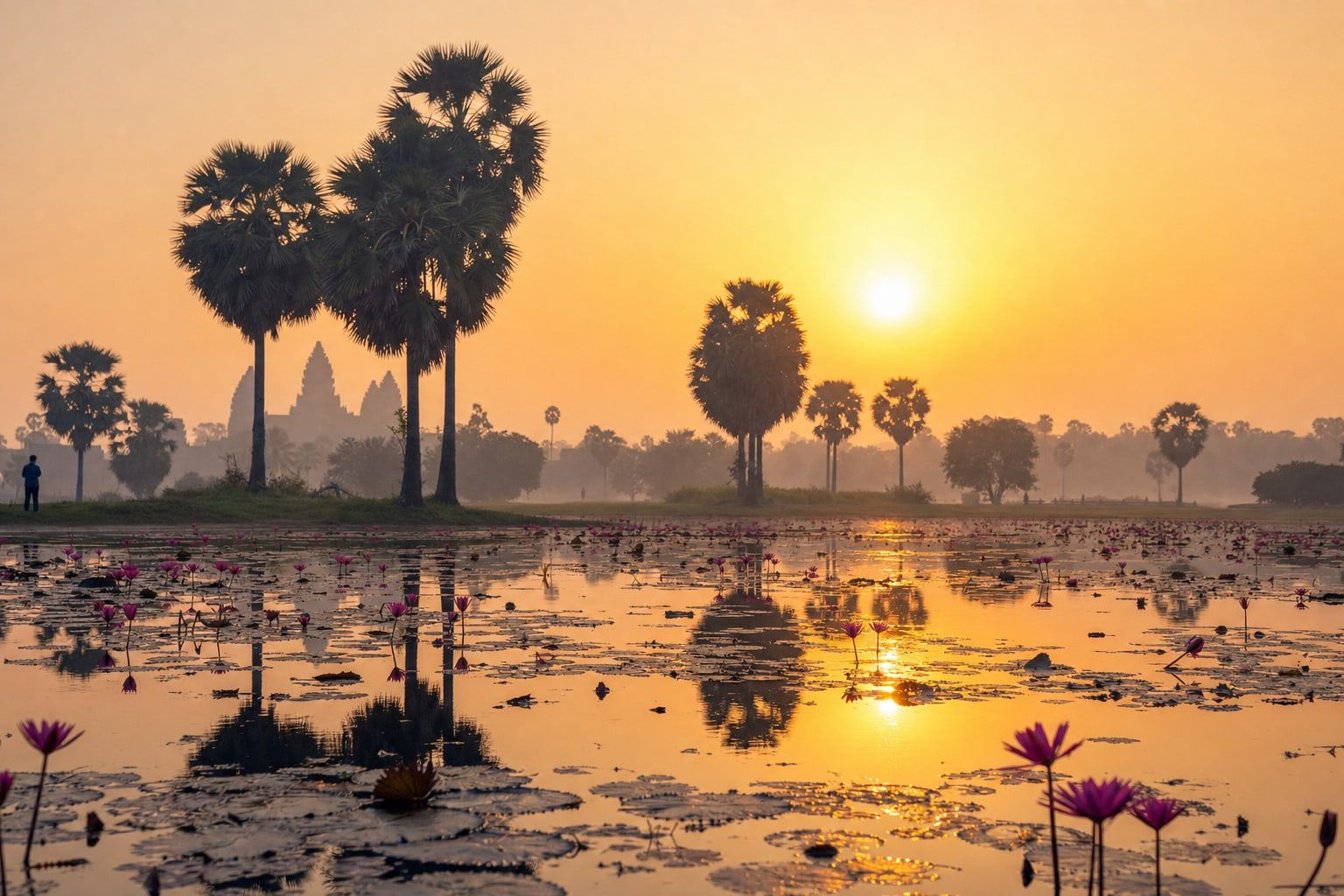
Angkor Wat, built in the first half of the twelfth century near present-day Siem Reap in Cambodia, is the largest religious monument in the world. Unlike most temples in the region it faces west, and that orientation makes sunrise behind its towers one of the best-known sights in Southeast Asia.
The equinox alignment
Seen from the western entrance and causeway, at the spring equinox the sun rises almost directly over the central tower, the tallest of the temple’s five lotus-bud towers. Around the September equinox the effect repeats. Researchers have argued that this alignment, along with others in the temple’s dimensions, was intentional, though the details are debated.
Around the equinoxes, Angkor Wat draws particularly large crowds at dawn. Calculated with the standard sunrise rule, on the March equinox of 2027 the sun rises over the site at about 06:08 Cambodia time (UTC+7, no daylight saving). The towers sit above the flat horizon, so the sun appears behind the central tower a few minutes after the calculated sunrise.
On ordinary mornings
The rest of the year the sun rises to the north or south of the central tower, depending on the season. Many visitors still find sunrise the best time to come: the light behind the silhouette is soft, the moat and the reflecting pools to the north of the causeway mirror the towers, and the heat has not yet set in.
Where to stand
- The reflecting pool, north of the causeway inside the outer wall, gives the classic view of the five towers mirrored in water. It is also the most crowded.
- The south pool, often quieter.
- Further back on the causeway, for a wider view with fewer people in front of you.
Arrive while it is still dark. Civil twilight here, close to the tropics, lasts only about 20 to 25 minutes, so the sky changes quickly.
Planning the visit
An Angkor Pass is required for the archaeological park, with options for one or several days. The temples open early for sunrise visitors. Bring a torch for the walk in, water, and clothing that covers shoulders and knees for entering the temple itself.
The numbers at the equinox
Calculated for the temple on an ideal flat horizon, the sun rises on 20 March 2027 at about 06:09 at an azimuth of about 90.2 degrees, and on 21 March at about 06:08 at 89.8 degrees, within a fraction of a degree of due east both mornings. In September it rises on 23 September at about 05:53 at 89.7 degrees. Near the tropics the rising point moves slowly even around the equinoxes, so the sun appears behind or close to the central tower for several mornings either side of each date.
The swing over the year is modest at this latitude, about 13 degrees north of the equator: the sun rises at about 66 degrees at the June solstice, 05:38 on 21 June 2027, and at about 114 degrees at the December solstice, 06:22 on 21 December 2026. Over the year it moves through less than 50 degrees of horizon, compared with nearly 80 at Stonehenge.
The temple and its plan
Angkor Wat was built under King Suryavarman II and dedicated to Vishnu, which may help explain its westward orientation, since the west is associated with Vishnu in some Hindu traditions; another long-standing view links it to a funerary purpose. The temple stands within a moat about 190 metres wide, enclosing an area of roughly 1.5 by 1.3 kilometres. From the causeway the five towers appear one behind the other, and the central tower rises about 65 metres above the ground. The temple was later used for Buddhist worship and has never been entirely abandoned, which is one reason it is better preserved than many neighbouring sites.
When to go
Cambodia has two main seasons. From November to February the weather is driest and coolest, with clear dawns and temperatures in the low twenties Celsius before sunrise. March and April are the hottest months, often above 35 °C by midday, and hazy skies are common, so the equinox sunrise in March is frequently softened by haze. From May to October the monsoon brings showers and cloud, but also the most dramatic skies and full reflecting pools. Many photographers prefer the September equinox for the reflections, accepting the risk of cloud.
The light in the first minutes
Because Angkor lies close to the tropics, the sun climbs steeply. Civil twilight, when the sky is bright enough to see the temple clearly, lasts only about 21 minutes before sunrise at the March equinox, compared with well over half an hour in northern Europe. The silhouette of the towers is sharpest in the last ten minutes before the sun appears, and once the sun clears the towers the light turns hard quickly. For a photograph with colour in the sky and detail in the stone, the minutes just before sunrise matter more than the moment itself. A wide lens from the edge of the reflecting pool takes in both the towers and their reflection; a longer lens from the back of the causeway compresses the towers against the rising sun, which then looks larger behind the central spire.
A sunrise at Angkor as a gift
For couples who travelled through Cambodia, or anyone who has stood on that causeway at dawn, a sunrise over Angkor Wat is a strong memory to mark. You can pin the reflecting pool or the temple itself and see the exact time of The Sunrise there before you decide.