
Goraiko: watching sunrise from the summit of Mount Fuji
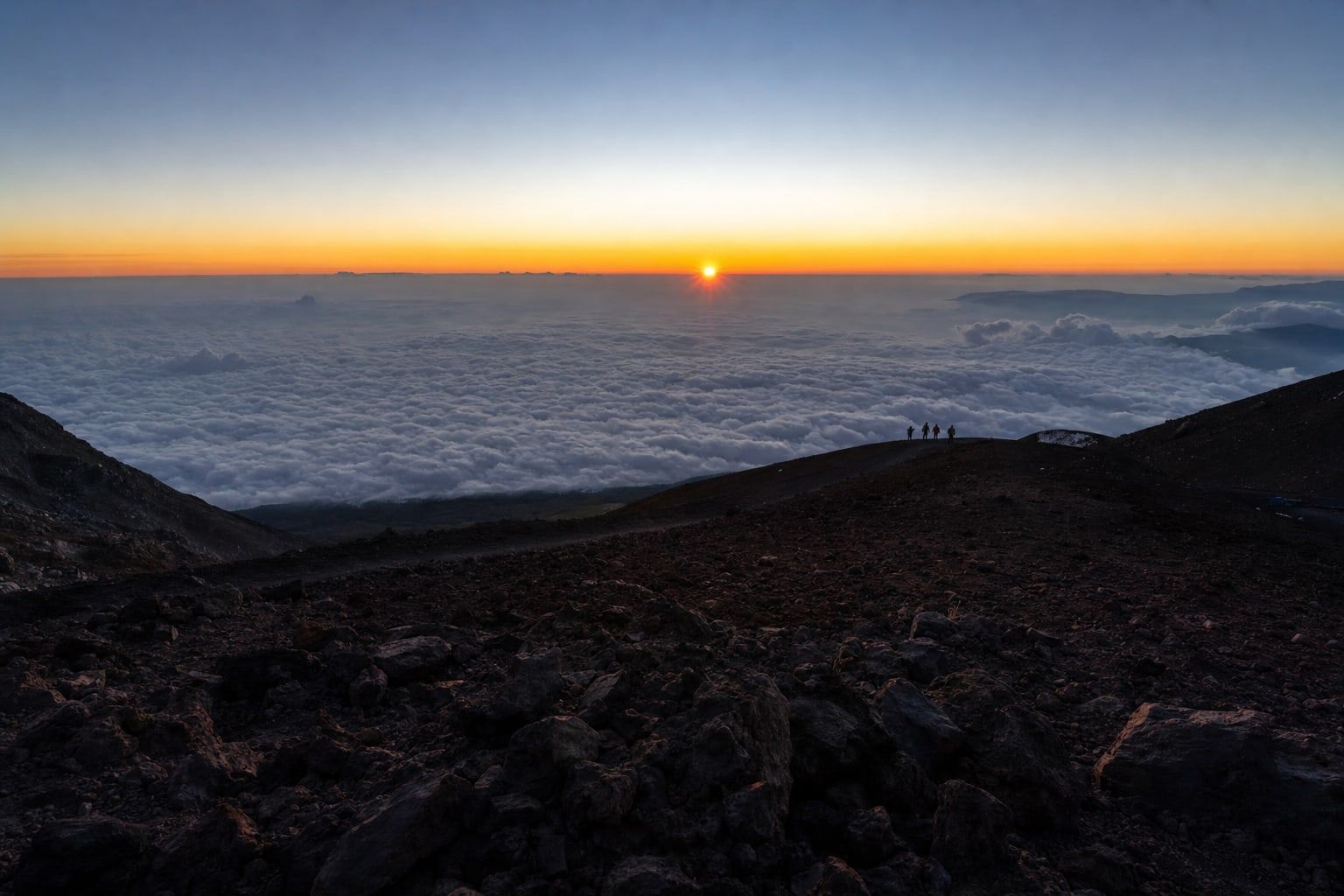
Mount Fuji, at 3,776 metres, is Japan’s highest mountain, and for many climbers the goal is not just the summit but the sunrise seen from it. Japanese has a special word for this: goraiko (御来光), an honorific term for the arrival of the light, watched from a high mountain.
The climbing season
The official climbing season on the main trails runs in summer, usually from early July to early September, when the huts are open and the routes are managed. Outside that window the mountain is snow-covered, conditions are dangerous, and climbing is strongly discouraged. Rules on the Yoshida trail now include a daily climber limit and an entry fee; check the current arrangements for the year you plan to go.
Timing the summit for sunrise
Calculated with the standard rule for the summit, sunrise on 1 August 2027 is at about 04:53 Japan time. From the summit, the horizon lies well below eye level, so the sun appears earlier than that: the horizon is lowered by almost two degrees, which at that time of year means about ten minutes earlier, over a sea of cloud to the east.
Most climbers do one of two things:
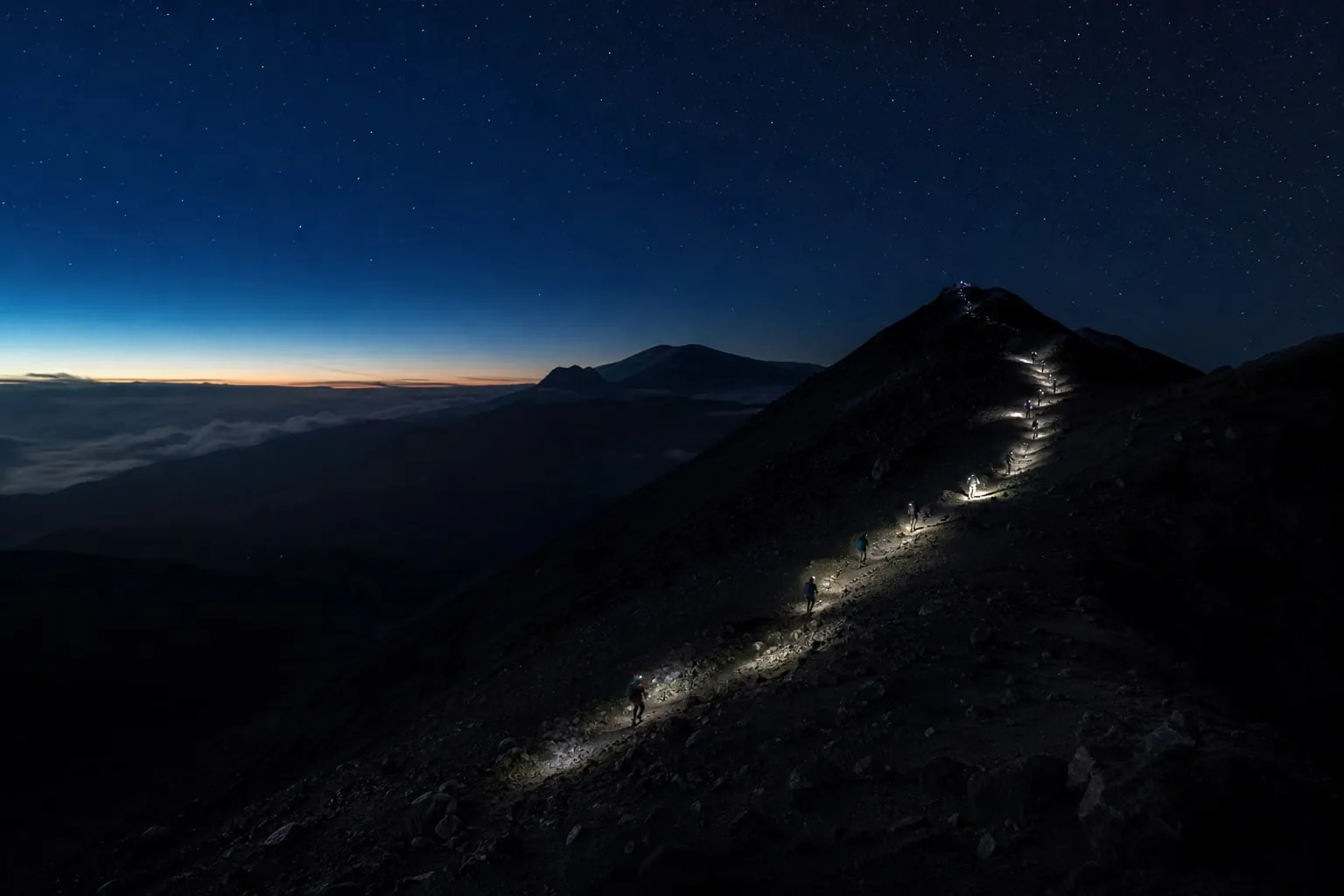
- Climb in the afternoon, sleep in a hut at the 7th or 8th station, and set off again around 2 a.m. to reach the top before dawn.
- Climb through the night without stopping, sometimes called bullet climbing. This is discouraged, as it sharply raises the risk of altitude sickness.
Leave plenty of margin. In peak season the trail near the top can form queues, and arriving after sunrise is a common disappointment.
What it is like
It is cold. Even in August the summit is often near freezing before dawn, with strong wind. The light comes first as a thin band of orange over the cloud layer, which at that height usually lies far below. When the sun clears it, the shadow of the mountain is sometimes projected westward across the clouds and the land, a long dark triangle called kage-Fuji.
Sunrise through the season
The summit sunrise moves noticeably over the climbing season. Calculated with the standard rule for a sea-level horizon, it comes at about 04:34 on 1 July 2027, 04:54 on 1 August and 05:17 on 1 September, Japan time. Seen from the summit, with the horizon lowered by the height of the mountain, each of these is about nine to ten minutes earlier. Early July therefore gives the earliest and longest dawn, while late August brings a sunrise more than half an hour later, which makes a pre-dawn start from the huts a little less brutal.
The sea of clouds, unkai, is the other half of the spectacle. On many summer mornings a layer of cloud lies well below the summit, and the sun comes up over it rather than over the Pacific. The clouds also hide the horizon itself, so the moment you see the disc can differ from the calculated time by a minute or two in either direction, depending on how high the cloud tops reach.
Trails and timings
Four main trails start from fifth stations at different heights. The Yoshida trail on the Yamanashi side, the busiest, begins at about 2,300 metres; the Fujinomiya trail on the Shizuoka side starts highest, around 2,400 metres, and is the shortest route to the summit; the Subashiri and Gotemba trails start lower and are quieter. A typical ascent from the fifth station takes five to seven hours for a fit walker, and the descent three to four. The rim of the crater is about three kilometres around; walking it, the ohachi-meguri, takes about an hour and a half and passes the true high point, Kengamine.
The Yoshida trail faces east and southeast, so climbers still on the upper slopes at dawn often see the goraiko from the trail itself. Many huts on the upper Yoshida route are placed with that view in mind.
Altitude and the cold
Altitude sickness becomes common above about 2,500 metres and is the main medical risk on Fuji. Headache, nausea and unusual tiredness are warning signs; the remedy is to slow down, drink, and descend if symptoms grow. Spending the night at a hut around 3,000 metres helps the body adjust. The summit is cold even in August, with temperatures often only a few degrees above freezing before dawn and a strong wind; warm layers, gloves, a hat and a waterproof shell are essential, along with a headlamp for the night section.
The shadow on the clouds
Just after sunrise, with the sun low behind the climber, the summit casts its shadow westward. Because the mountain is a near-perfect cone and the sun is close to the horizon, the shadow appears as a sharp triangle stretching for tens of kilometres across the cloud sea or the land below: kage-Fuji. It lasts only a short time and is best seen from the western part of the crater rim.
If you cannot climb
Some people watch the goraiko from the Fuji Five Lakes area or from the 5th station, where the sun rises behind the mountain’s shoulder rather than in front of it. Others mark it from far away.
A sunrise at Fuji’s summit happens every morning of the year, including the long months when nobody can be there. You can pin the summit, or a lake shore with a view of the mountain, and dedicate The Sunrise there to someone who made the climb, or still plans to.