
Which night is the full moon night? A precise answer
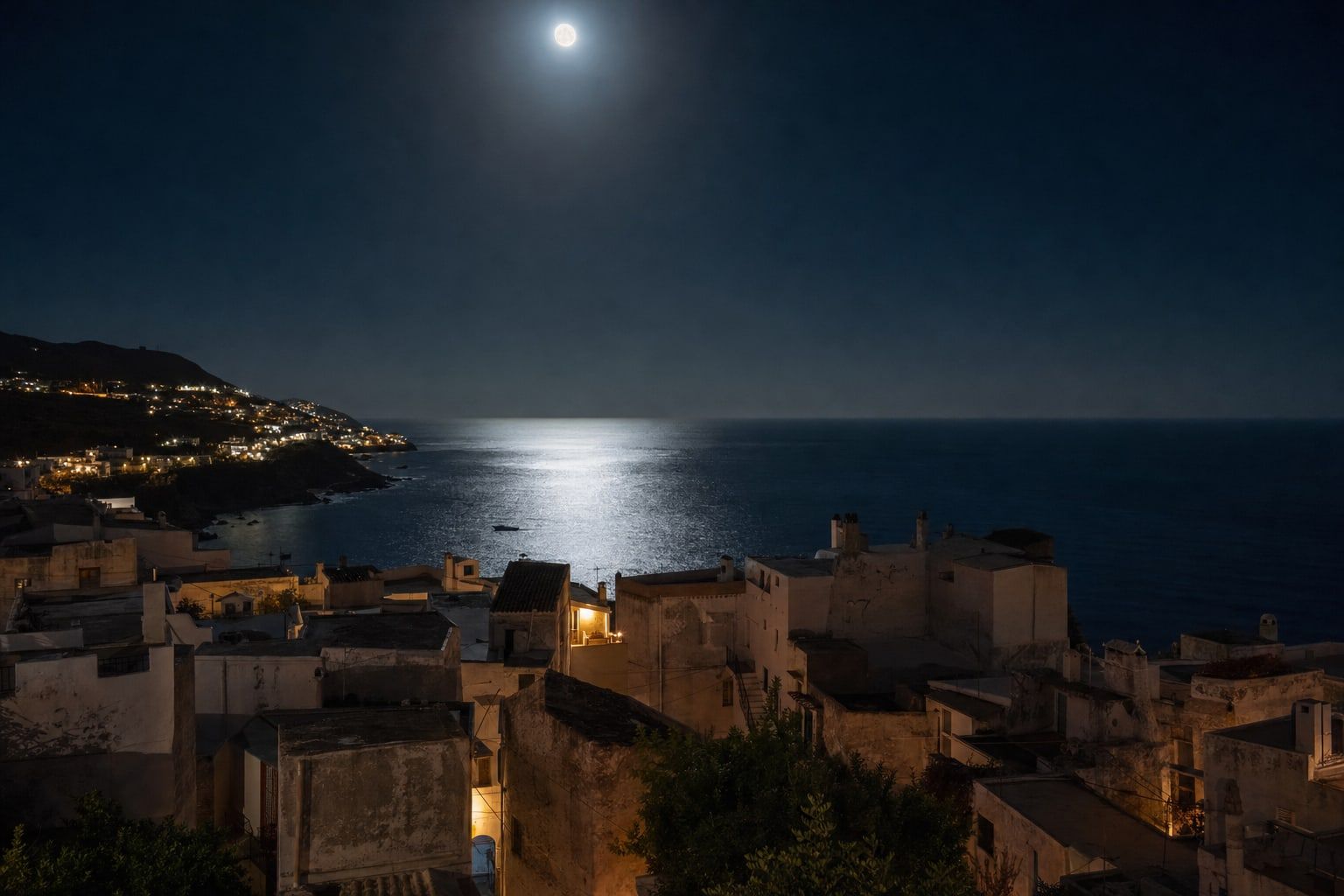
Calendars say “full moon: 26 October”. Astronomers say “full moon: 04:11 UTC on 26 October 2026”. A person standing in Tokyo or Chicago asks a simpler question: which night should I go outside? The three answers do not always line up, and a gift tied to a full moon needs one clear rule.
The instant
The full moon is the moment when the moon’s ecliptic longitude is exactly 180° from the sun’s, so the moon stands opposite the sun as seen from Earth. It is calculated from the orbital motion of the Earth and moon with standard algorithms (Jean Meeus’s Astronomical Algorithms is the usual reference) and is the same instant everywhere.
The night
A night is local. It starts at sunset and ends at sunrise at a particular point, so its length and its clock times vary with latitude, season and longitude. The full moon night, as Resthe defines it, is:
the local night, from sunset to sunrise at your point, whose middle is closest to the astronomical moment of full moon.
The Full Moon Night you dedicate is the nearest such night, or the first one from a day you choose; its sunset always comes after your payment.
Three examples for 26 October 2026
The full moon falls at 04:11 UTC.
- New York. That is 00:11 local time, close to the middle of the night of 25 to 26 October. That night is the full moon night.
- London. That is 05:11 local time after the clocks change, near the end of the night of 25 to 26 October. The middle of that night is still much closer to the full moon than the middle of the following night, so 25 to 26 October it is.
- Tokyo. That is 13:11, in the middle of the day. The middle of the previous night, around 23:30 on 25 October, is about thirteen and a half hours earlier; the middle of the following night, around 23:30 on 26 October, about ten hours later. The rule picks the night of 26 to 27 October. On both nights the moon is more than 99% illuminated.
Three more places, the same instant
The same moment, 04:11 UTC on 26 October 2026, lands differently again in the Southern Hemisphere and in Asia:
- Rio de Janeiro: 01:11 local time, in the small hours of 26 October. The full moon night runs from sunset at about 18:01 on 25 October to sunrise at about 05:11.
- Cape Town: 06:11 local time, just after sunrise. The night that ends at about 05:52 that morning, having begun at about 19:08 on 25 October, is the full moon night.
- Delhi: 09:41 local time, mid-morning. The night of 25 to 26 October, from about 17:42 to 06:28, has its middle less than ten hours before the full moon, much closer than the next night. It is the full moon night in Delhi.
In every one of these places the moon looks full on both neighbouring nights. The rule exists so that a certificate names one night without hesitation, and so that anyone with an almanac can check it.
Why not simply use the calendar date?
A calendar date seems easier: the full moon is on 26 October, so 26 October is the night. But calendar dates are written in one time zone, usually UTC or the publisher’s own. For someone in Rio, “26 October” would point to the evening of the 26th, a full day after the instant, when the moon is already a little past full. For someone in Tokyo it would happen to be right. A rule tied to the local night removes that accident of time zones.
Why not the night that contains the instant?
Another option is the night during which the full moon happens. That works whenever the instant falls in darkness, as in New York or Rio. When it falls in daylight, as in Delhi or Tokyo, no night contains it, and a second rule would be needed anyway. Choosing the night whose middle is closest covers every case with a single sentence.
A rule you can check yourself
The definition needs only three published facts: the moment of full moon, and the times of sunset and sunrise at your point. Any almanac or astronomy app supplies them. Find the night whose midpoint is nearest the full moon, and you have the same night the certificate names.
The far north
Near the poles the rule meets its limits. In summer, a point inside the Arctic Circle may have no night at all, only a sun that never sets. In that case there is no full moon night to dedicate, and the site tells you so before you pay. In winter the reverse can happen: a night may last for weeks, and the rule then applies to that single long night.
What appears on the certificate
A full moon night certificate records the place, the local date and the night, the exact moment of full moon, and the moon’s illuminated fraction at that moment, almost always 100.0% when rounded. All of it is calculated, not observed, so cloud cover does not change it.
If you want the next full moon over a particular place, pin it in The Full Moon Night and you will see the night the rule picks. For a wedding or engagement, Our First Full Moon Night finds the first full moon night on or after that date.