
The Hunter’s Moon of 26 October 2026
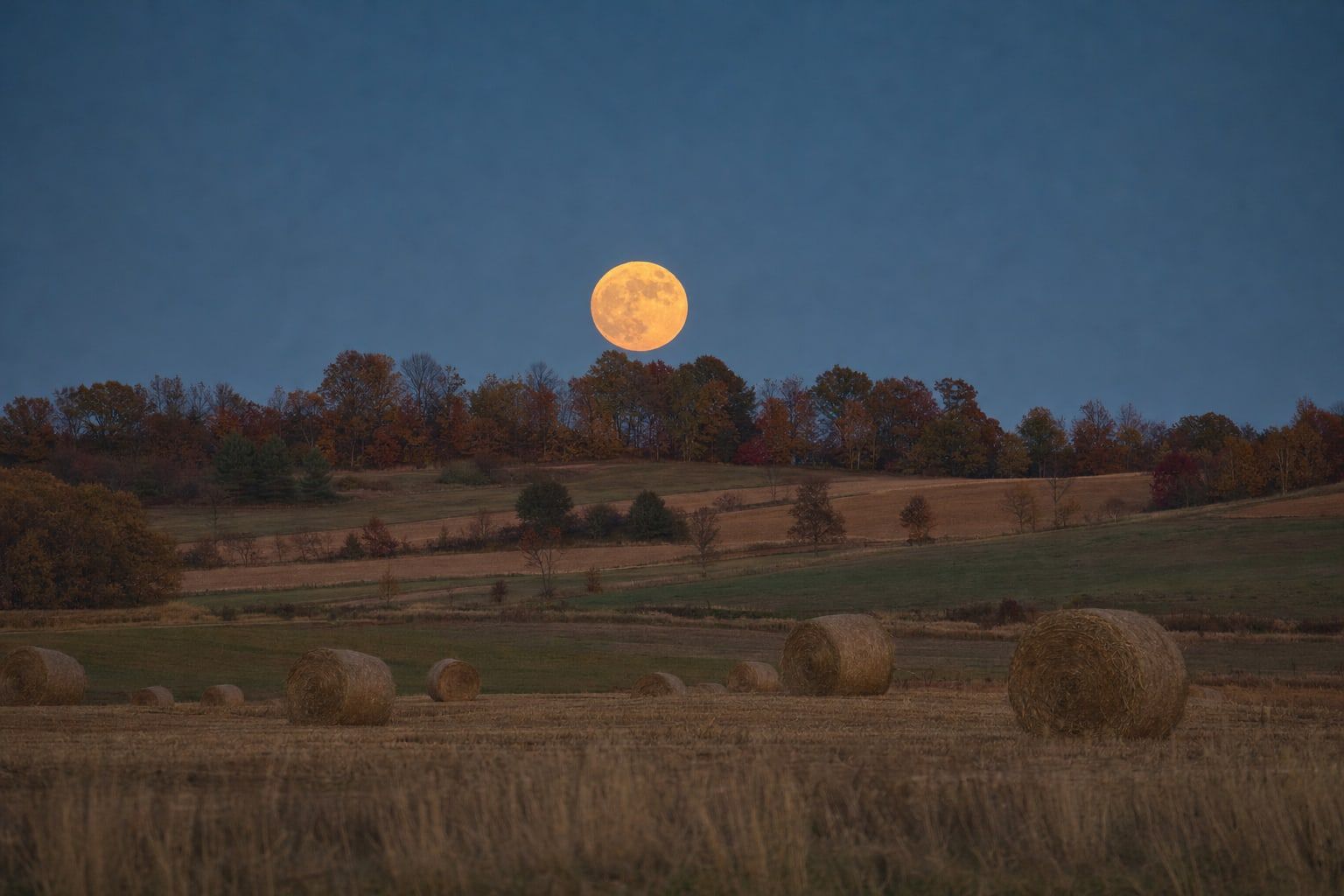
The next full moon reaches its exact moment at 04:11 UTC on Monday, 26 October 2026. In the Northern Hemisphere tradition this is the Hunter’s Moon, the first full moon after the Harvest Moon, which is the full moon nearest the September equinox.
What “full” actually means
A full moon is not a whole night or a whole day. It is an instant: the moment when the moon stands exactly opposite the sun in ecliptic longitude, 180° away as seen from Earth. On either side of that instant the moon looks full to the naked eye for a day or more, which is why the whole night around it feels like “the full moon”.
Because it is one instant, the date depends on where you are. 04:11 UTC is:
- 00:11 on 26 October in New York (EDT),
- 05:11 on 26 October in London (GMT, after the clocks change on 25 October),
- 13:11 on 26 October in Tokyo,
- 21:11 on 25 October in Los Angeles (PDT).
So people in the Americas will see the most full moon on the night of 25 to 26 October, and people in Europe and Africa will see it in the hours before dawn on 26 October.
Why the Hunter’s Moon rises early
Around the September equinox and for a few weeks after, the moon’s path meets the eastern horizon at a shallow angle in the evening for observers at mid-northern latitudes. The result is that, night after night, the moon rises only a little later than the night before, rather than the usual 50 minutes or so. Bright moonlight arrives soon after sunset several evenings in a row. Farmers used that light to finish the harvest, and hunters to track game across cleared fields, which is where the traditional names come from.
Moonrise before sunset
On the evening before the exact full moon, the moon comes up a little before the sun goes down. Calculated for 25 October 2026:
- New York: moonrise about 17:26, sunset about 18:01.
- London: moonrise about 16:01, sunset about 16:46 (clocks have just gone back).
- Paris: moonrise about 16:57, sunset about 17:42.
For roughly three quarters of an hour, the sun is low in the west and the nearly full moon is low in the east at the same time. It is the best moment to see the moon against a still-blue sky, with landscape detail around it.
How bright a full moon is
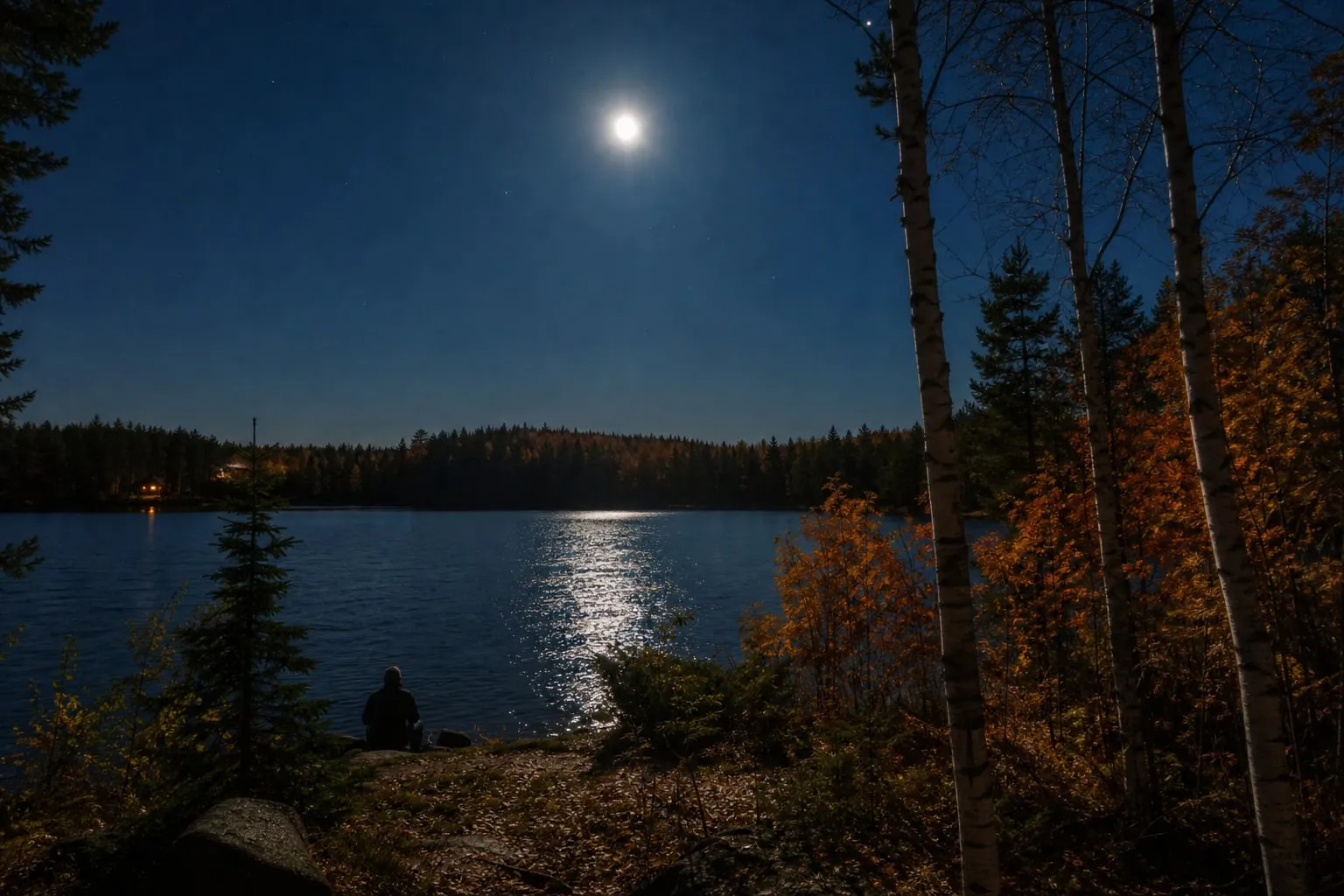
The full moon reaches an apparent magnitude of about −12.7. That is the brightest object in the night sky by far, yet roughly 400,000 times fainter than the sun. It is bright enough to cast clear shadows and to read large print outdoors, but not to show colour: under moonlight the eye relies on rod cells, which see in shades of grey and are most sensitive to blue-green. That is why moonlit landscapes look silver and cold even though moonlight is simply reflected sunlight.
Which night is the full moon night?
If a full moon is an instant, which night do you circle in the calendar? Resthe uses a simple, published rule: the full moon night is the local night, from sunset to sunrise at your point, whose middle is closest to the astronomical moment of full moon.
For most places the answer is obvious. In New York the moment falls just after midnight, so the full moon night is the night of 25 to 26 October. In London it falls a little before sunrise, so it is the same night. In Tokyo it falls in the early afternoon, and the rule picks whichever neighbouring night has its middle closer to that moment.
How to see it well
- Look east at sunset. A full moon rises roughly as the sun sets, opposite it in the sky.
- Catch the moonrise. Near the horizon the moon looks orange and, to most people, larger. The colour is real, caused by the long path through the atmosphere; the size is an illusion.
- Let your eyes adapt. Ten minutes away from screens makes the landscape under moonlight surprisingly detailed.
Photographing it
- Shoot at moonrise. A moon high in a dark sky is either a white disc or a black landscape; there is too much contrast for one exposure. Near the horizon at dusk the sky and the moon are close in brightness.
- Use a long lens and a distant subject. A tower or a hill a kilometre away, with the moon behind it, makes the moon look large relative to the subject.
- Expose for the moon. The full moon is in direct sunlight; a fast shutter speed keeps its surface detail.
In the Southern Hemisphere
The names Harvest and Hunter’s Moon belong to the northern autumn. In Sydney or Buenos Aires, the 26 October full moon is a spring moon, and the shallow-angle effect that makes northern Hunter’s Moons rise early in the evening works the other way: there, the moon rises noticeably later each night. The astronomical moment is the same instant everywhere.
The next full moon after this one comes on 24 November 2026 at 14:53 UTC.
A full moon night can be dedicated to someone at any place on Earth, with the exact moment of full moon and the moon’s illumination on the certificate. You can pin the place and see which night it is with The Full Moon Night.