
Polar night in Tromsø: the weeks without a sunrise
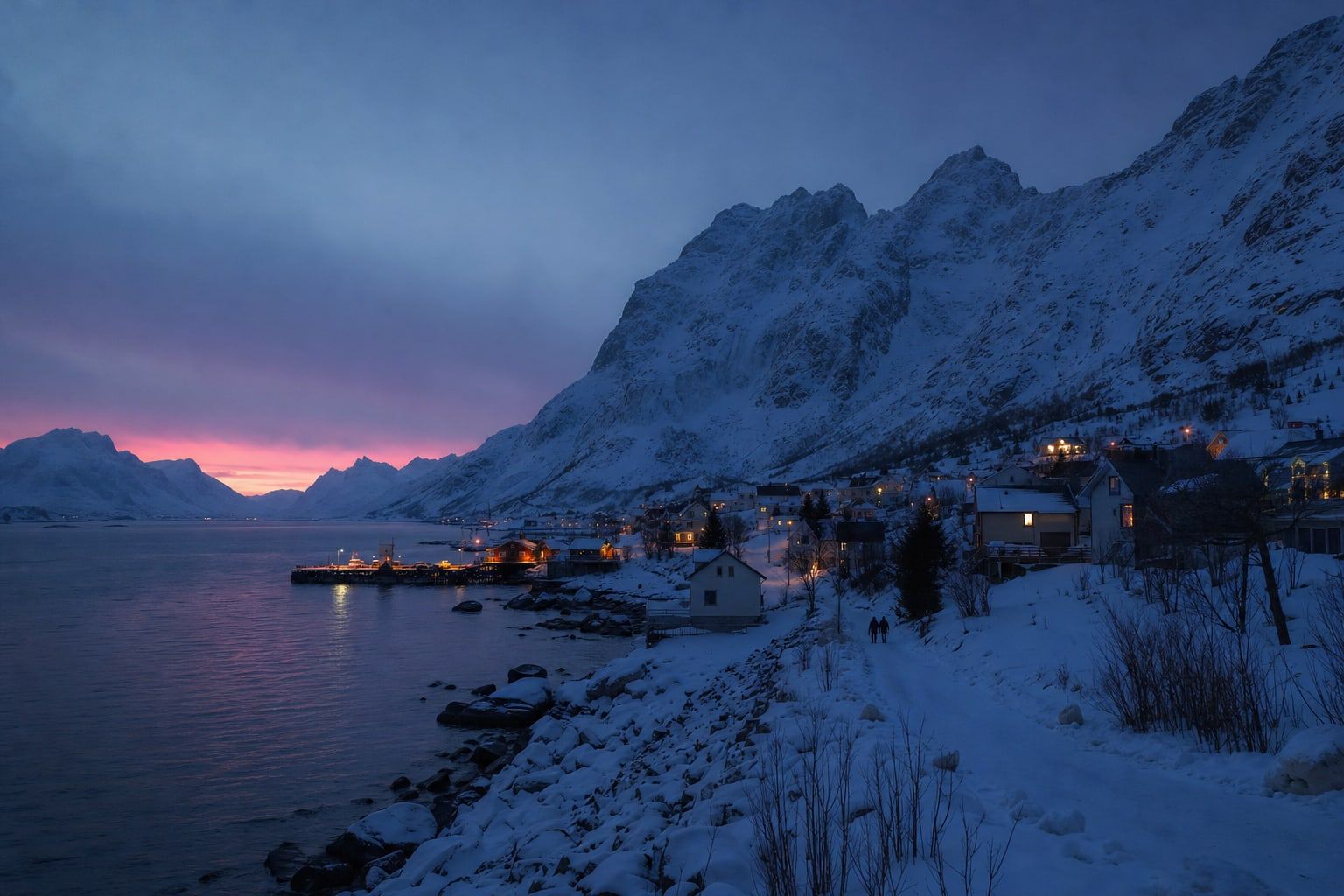
Tromsø sits at about 69.6° north, roughly 350 kilometres inside the Arctic Circle. That latitude gives the city two seasons that most of the world never experiences: a stretch of winter when the sun does not rise at all, and a stretch of summer when it does not set.
The dates for this winter
Calculated with the standard sunrise rule for central Tromsø, the last sunrise of 2026 comes on 27 November. It is a short appearance: on the day before, 26 November, the sun rises at about 10:57 local time and sets at 12:05, a little over an hour above the horizon. After the 27th, the sun stays below the horizon all day.
The first sunrise of the new year comes on 15 January 2027. Between those dates, about seven weeks, there is no sunrise in Tromsø.
The summer counterpart is longer. The last sunset of spring comes around 17 May 2027, and the sun does not set again until 26 July. For about ten weeks it circles the sky without dipping below the horizon.
Polar night is not pitch black
“Polar night” sounds like constant darkness, but at Tromsø’s latitude it is not. Around midday the sun is only a few degrees below the horizon, which places the city in civil or nautical twilight for several hours. The southern sky turns deep blue, then rose and orange, and the light is soft enough to walk, ski and read outdoors without a lamp. Locals call this period mørketid, the dark time, and many describe the colours as the best of the year. Even at the December solstice, the darkest day, the sun at noon is only about 3.1° below Tromsø’s horizon, well inside civil twilight, so the middle of the day is never truly dark there.
Much darker middays happen further north. In Longyearbyen on Svalbard, at 78° north, the sun at midwinter noon is still more than 11° below the horizon, and for about eleven weeks around the solstice even midday never reaches civil twilight.
Why the dates shift slightly from place to place
Polar night does not begin on the same day across northern Norway. A few kilometres of latitude, a mountain on the southern horizon or a position on an island’s north side can move the last visible sunrise by days. The dates above are astronomical: an ideal flat horizon, standard refraction, the upper edge of the sun. A valley shaded by peaks will lose the sun earlier and see it back later; locals in such places often celebrate the “sun day” when it first clears the ridge.
The midnight sun, the other half of the year
In summer the situation reverses. From about 17 May to 26 July 2027 the sun does not set over central Tromsø. At midnight it sits low in the north, a few degrees above the horizon, and the light has the warm colour of an evening that never ends. Many visitors find this harder to adjust to than the dark: blackout curtains are standard in Tromsø hotels for a reason.
The midnight sun lasts longer than the polar night for two reasons. The sun’s disc has size, and sunrise is defined by its upper edge, which shortens nights and lengthens days at both ends. And refraction lifts the sun by more than half a degree near the horizon, keeping it visible when it is geometrically just below.
Northern lights and the dark season
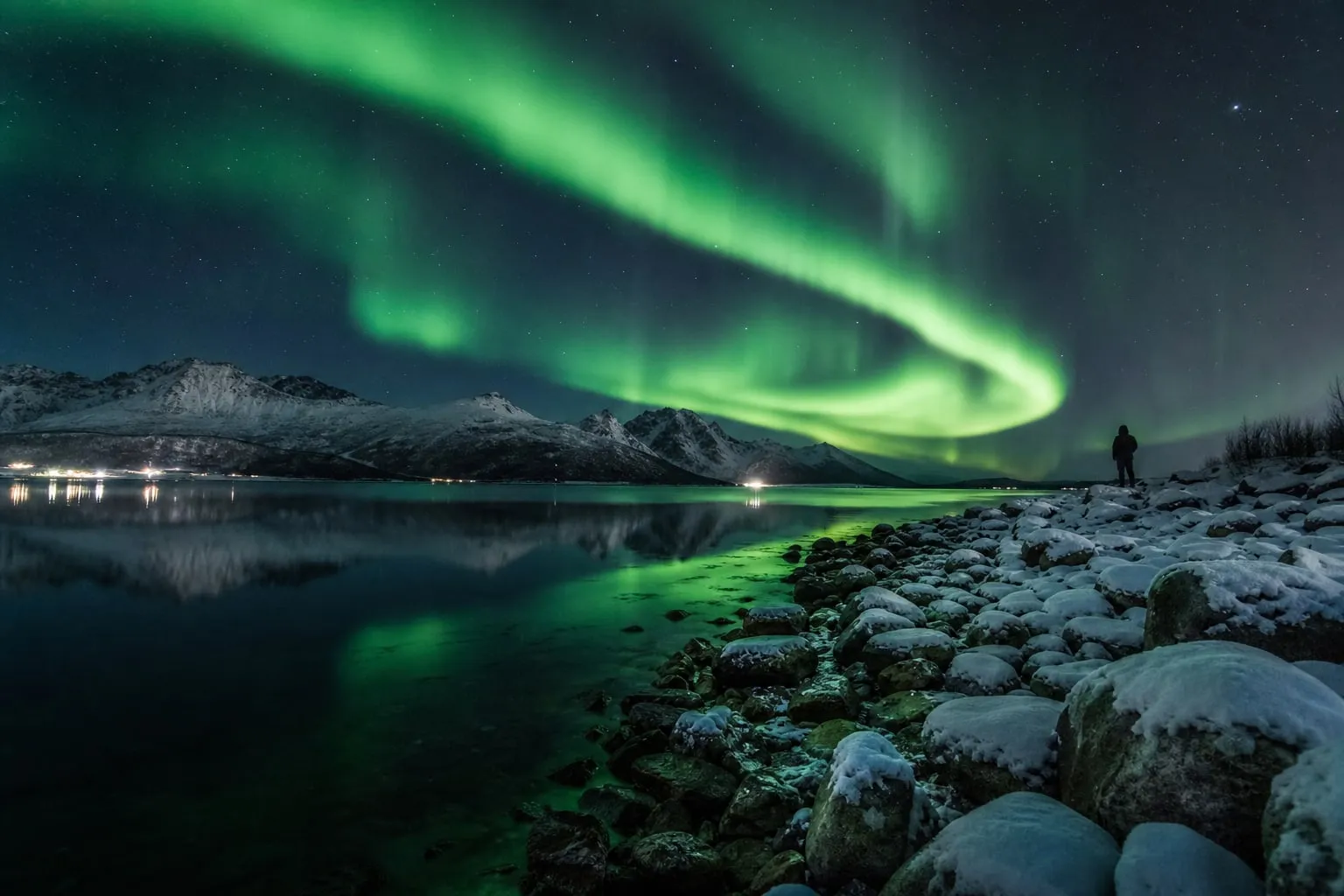
The weeks of polar night are also the heart of the aurora season. Tromsø lies under the auroral oval, the band around the magnetic pole where the northern lights are most frequent, and from roughly September to early April the sky is dark enough to see them. The aurora does not depend on the polar night, but the long hours of darkness give many more chances each day. Clear, cold nights away from the city lights of the island give the best views.
How locals live with it
Life does not stop. Schools, offices and shops keep their normal hours under street lights. People ski on floodlit trails, go to the cinema and concerts, and spend time outdoors in the blue midday light. Light therapy lamps are common, and so is a deliberate effort to keep routines regular. Visitors often notice that the polar night is quieter than they expected, and more beautiful.
When the sun comes back
The return of the sun is a genuine event in Tromsø. The astronomical sunrise returns on 15 January, but the mountains on the southern skyline hide the first low suns, and the city traditionally celebrates Soldagen, the sun day, on 21 January, when the sun is first seen from the town. Schools mark it, bakeries sell sun buns, and many people go out at midday to see the first thin arc over the hills. It is also a good example of how counting sunrises works in the far north: a year in Tromsø has well under 365 of them. Over the ten years from October 2016 to October 2026, by our calculation, central Tromsø had 2,479 sunrises, compared with 3,652 in Paris over the same period.
That difference matters if you are counting the sunrises a couple has shared. The Nth Sunrise counts them exactly, place by place, so polar nights and polar days are not counted as sunrises that never happened. For a sunrise still ahead at a northern place, The Sunrise shows before payment whether one occurs within the product window.