
Stonehenge and the solstice sunrise: what lines up
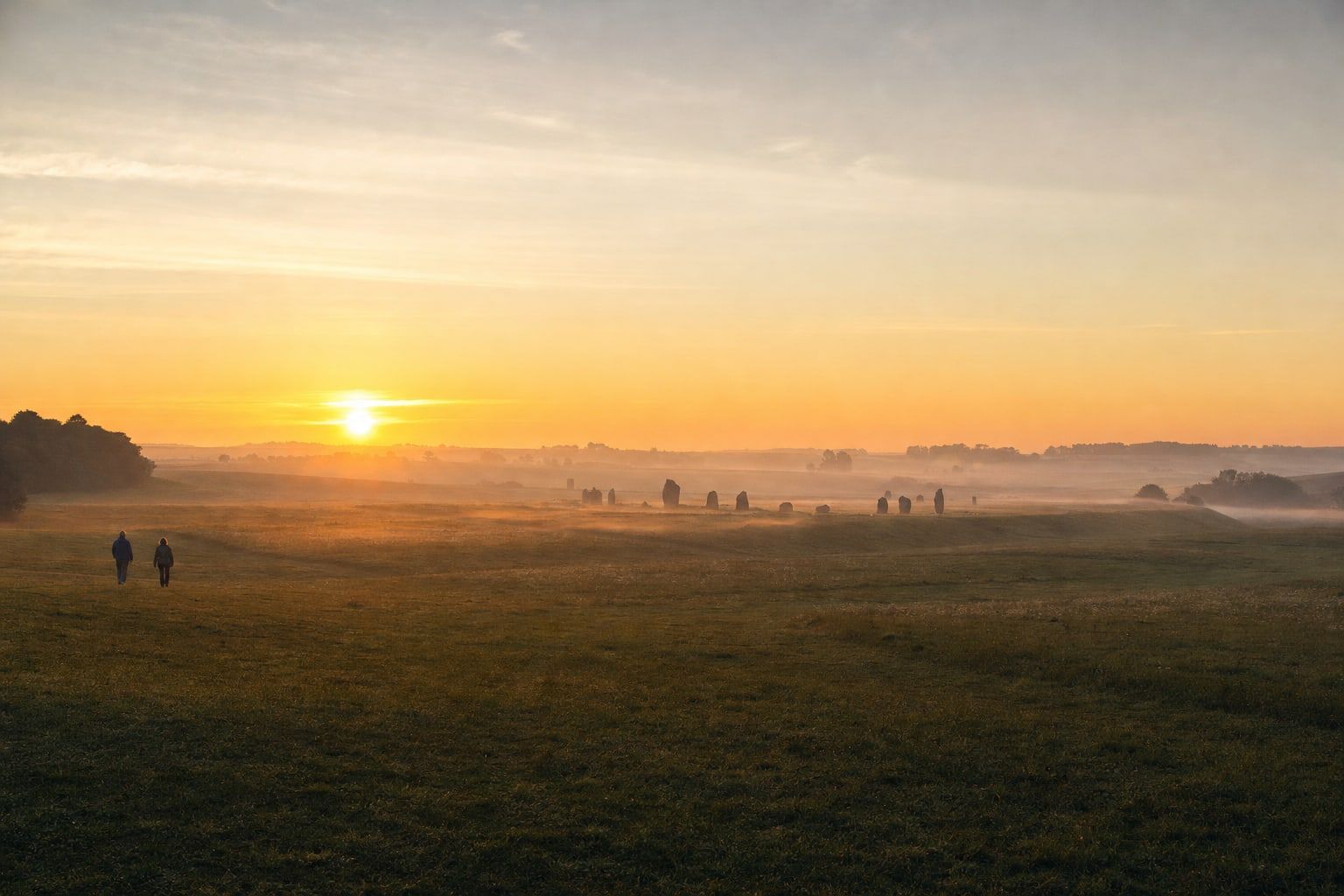
Stonehenge, on Salisbury Plain in Wiltshire, is the best-known prehistoric monument in Europe. Its main axis points toward the northeast, where the sun rises around the June solstice, and in the opposite direction toward the southwest, where it sets around the December solstice. Archaeologists generally agree that this alignment was deliberate.
The midsummer sunrise
Standing at the centre of the stone circle and looking out along the Avenue, the ceremonial earthwork leading away to the northeast, you see the Heel Stone, a large unshaped sarsen outside the circle. Around the June solstice the sun rises just to the left of it as seen from the centre. The alignment is close, not perfect: the sun’s rising point has shifted slightly over four and a half thousand years as the tilt of the Earth’s axis has changed, and the Heel Stone may once have had a partner stone beside it, framing the sunrise between them.
At the solstice the sun is rising at its most northerly point of the year. For a few days around 21 June it barely moves along the horizon, which is why the event is visible for several mornings rather than one.
The midwinter sunset
Many archaeologists now think that the winter solstice mattered as much as, or more than, the summer one. Looking from the Heel Stone toward the circle, the midwinter sun sets in the southwest through the gap of the largest trilithon, the great stone arch at the monument’s centre. Animal bones found at nearby Durrington Walls, a large settlement linked to Stonehenge, suggest feasting took place there in midwinter.
Visiting at the solstice
English Heritage, which manages the site, usually offers managed open access at the summer and winter solstices, when visitors can enter the stone circle itself. At other times, visitors walk around the stones on a path, a short distance away. Details, dates and conditions are published by English Heritage each year; check them well in advance, as arrangements vary.
An ordinary sunrise is still precise
On any morning of the year, the sunrise at Stonehenge can be calculated to the minute with the same rule used everywhere: the upper edge of the sun crossing an ideal horizon with standard refraction. On 15 October 2026, for example, sunrise there is at about 07:30 British Summer Time. The alignment matters at the solstices; the precision is the same every day.
The numbers for the coming year
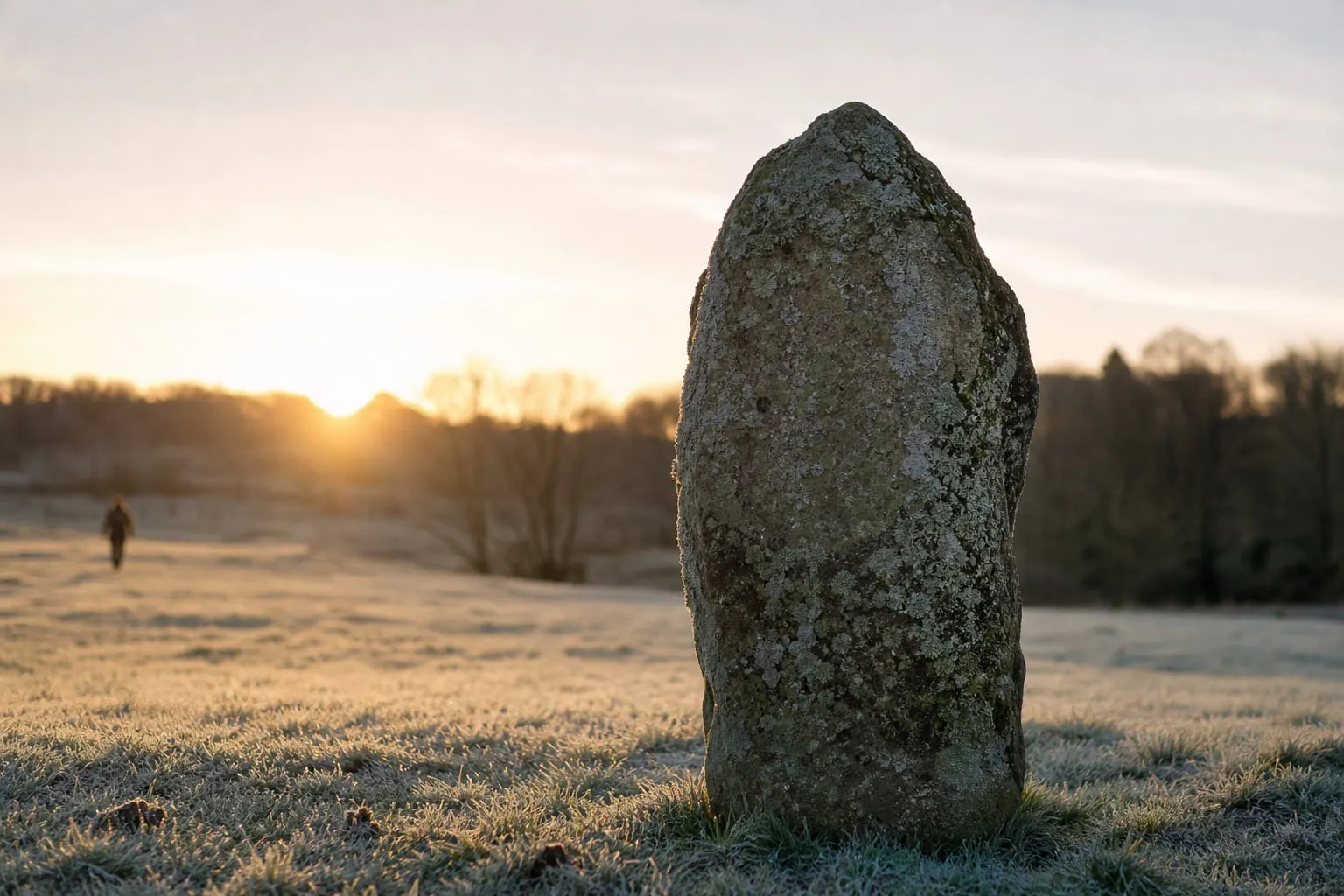
The alignment is easier to judge with real figures. Calculated for the centre of the monument on an ideal flat horizon, the midsummer sunrise on 21 June 2027 comes at about 04:51 British Summer Time, at an azimuth of roughly 49°, that is 49 degrees clockwise from true north. The sky is light long before that: civil twilight, when the sun is six degrees below the horizon and the stones are clearly visible, begins at about 04:04. The same evening the sun sets at about 21:26 at an azimuth near 311°, giving a day of about 16 hours 35 minutes.
Six months earlier, on 21 December 2026, the sun rises at about 08:08 GMT at an azimuth near 128° and sets at about 16:01 near 232°. The day lasts about 7 hours 53 minutes. On the spring equinox, 20 March 2027, sunrise is at about 06:10 GMT and almost due east, at 89°.
Two things follow from these numbers. First, the midsummer sunrise and the midwinter sunset point in almost opposite directions, about 49° and 232°, which is why a single axis through the monument can serve both. On a perfectly flat horizon they differ from an exact straight line by about two and a half degrees; the real skyline of Salisbury Plain, and the height at which you stand, shift both by small amounts. Second, the rising point of the sun swings through nearly 80 degrees of the horizon over the year at this latitude, from about 49° in June to about 128° in December. A builder who wanted to mark one particular day had a wide range to choose from, and chose the extremes.
Why the solstice lasts several days
The word solstice comes from the Latin for “the sun standing still”. Near the solstices the sun’s declination, its position north or south of the celestial equator, changes very slowly, so its rising point hardly moves from one morning to the next. Around 21 June the shift is a small fraction of a degree a day, far less than the width of the sun itself. That is why the midsummer sunrise over the Heel Stone looks almost the same for several mornings, and why cloud on the solstice itself does not mean waiting a whole year. In March and September, by contrast, the rising point moves quickly, by well over half a degree a day at this latitude.
The slow change over millennia
The tilt of the Earth’s axis is not fixed. When the main phases of Stonehenge were built, around 2500 BC, it was close to 24.0°, compared with about 23.44° today. With a larger tilt, the summer sun reached further north, so the solstice sunrise seen from Stonehenge stood roughly a degree further to the left than it does now, about two widths of the sun’s disc. The difference is small, but it is one reason why today’s midsummer sunrise does not sit exactly where a modern visitor might expect.
From an alignment to a dedication
People have marked the sun’s position for thousands of years because a sunrise is a dependable, shared event. Dedicating one to someone is a modern version of the same impulse. You can pin Stonehenge, or any landscape that matters to you, and see the exact time of The Sunrise before you choose.