
Sunset in Oia, Santorini: timing it right
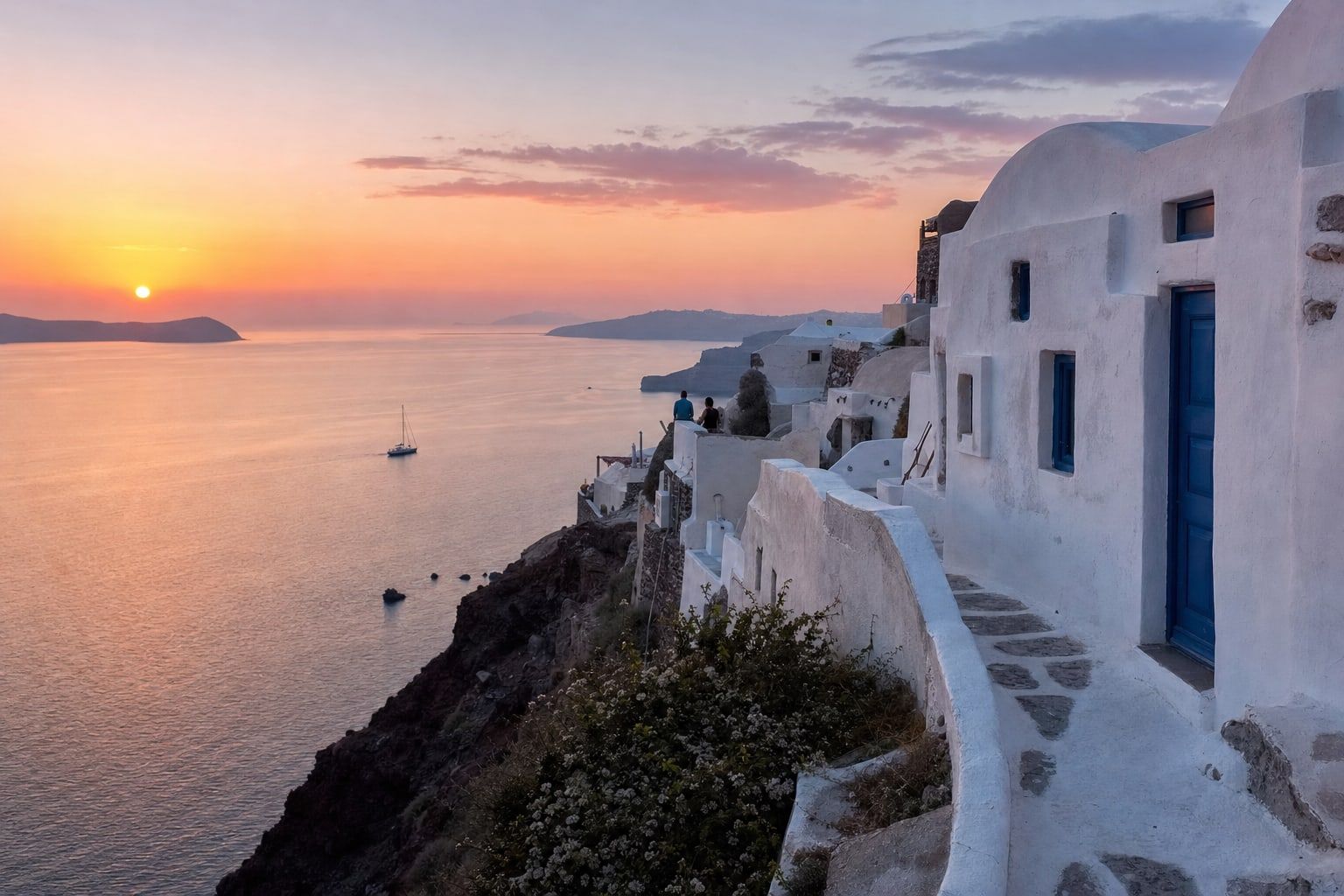
The village of Oia sits on the northern tip of Santorini, on the rim of a flooded volcanic caldera. Its whitewashed houses face west across the water, and on clear evenings the sun drops into the Aegean beside the island of Thirasia. It is one of the most photographed sunsets in Europe, and in high summer one of the most crowded.
What time the sun sets
Calculated with the standard rule for central Oia, the sun sets at about 18:42 local time on 15 October 2026. Through October the time moves earlier by roughly a minute a day. Greece changes from summer time (UTC+3) to winter time (UTC+2) on 25 October 2026, and the clock time of sunset jumps an hour earlier overnight, to about 17:30 at the end of the month.
In June, by contrast, the sun sets after 20:30. That later hour is part of why summer evenings are so busy: cruise passengers and day visitors can stay for it.
Where people watch
The best-known spot is around the ruins of the Byzantine castle at the western end of the village, which looks straight down the caldera toward the setting sun. On summer evenings the area fills an hour or more before sunset. Alternatives include the paths and steps below the main lane, the windmills further along the ridge, and the waterfront at Ammoudi Bay, about 300 steps down, where the sun sets behind the headland.
Why autumn is the better season
- Fewer people. Cruise traffic thins after September, and the castle area is manageable even close to sunset.
- A lower sun path. In October the sun sets further south along the horizon, closer to the line of the caldera rim and Thirasia, which many photographers prefer.
- Clearer air. After the summer haze, autumn evenings in the Cyclades are often sharper, with stronger colours in the twenty minutes after sunset.
Wind is the main risk: the meltemi and autumn northerlies can make the exposed rim cold after dark. Bring a layer.
Where on the horizon the sun sets
The sun does not set in the same place all year. Seen from Oia, at the June solstice it goes down far to the north-west, at an azimuth of about 300°, around 20:39 local time. At the December solstice it sets in the south-west, at about 241°, around 17:06. That swing of nearly 60° along the horizon changes the picture: in summer the sun drops into open sea to the right of Thirasia, while in winter it sets behind the line of the caldera rim to the left.
If a photograph in your mind has the sun over a particular islet or windmill, it matters which month it was taken in.
Getting there and getting back
Oia is at the northern end of the island, about 11 kilometres from Fira. Buses run between the two, but after sunset in high season they fill quickly, and taxis are scarce. Parking near the village is limited. Many visitors walk the caldera path from Imerovigli to Oia in the afternoon, roughly three to four hours on foot, and arrive in time for the sunset, which turns the walk into the reason for the day.
The caldera itself
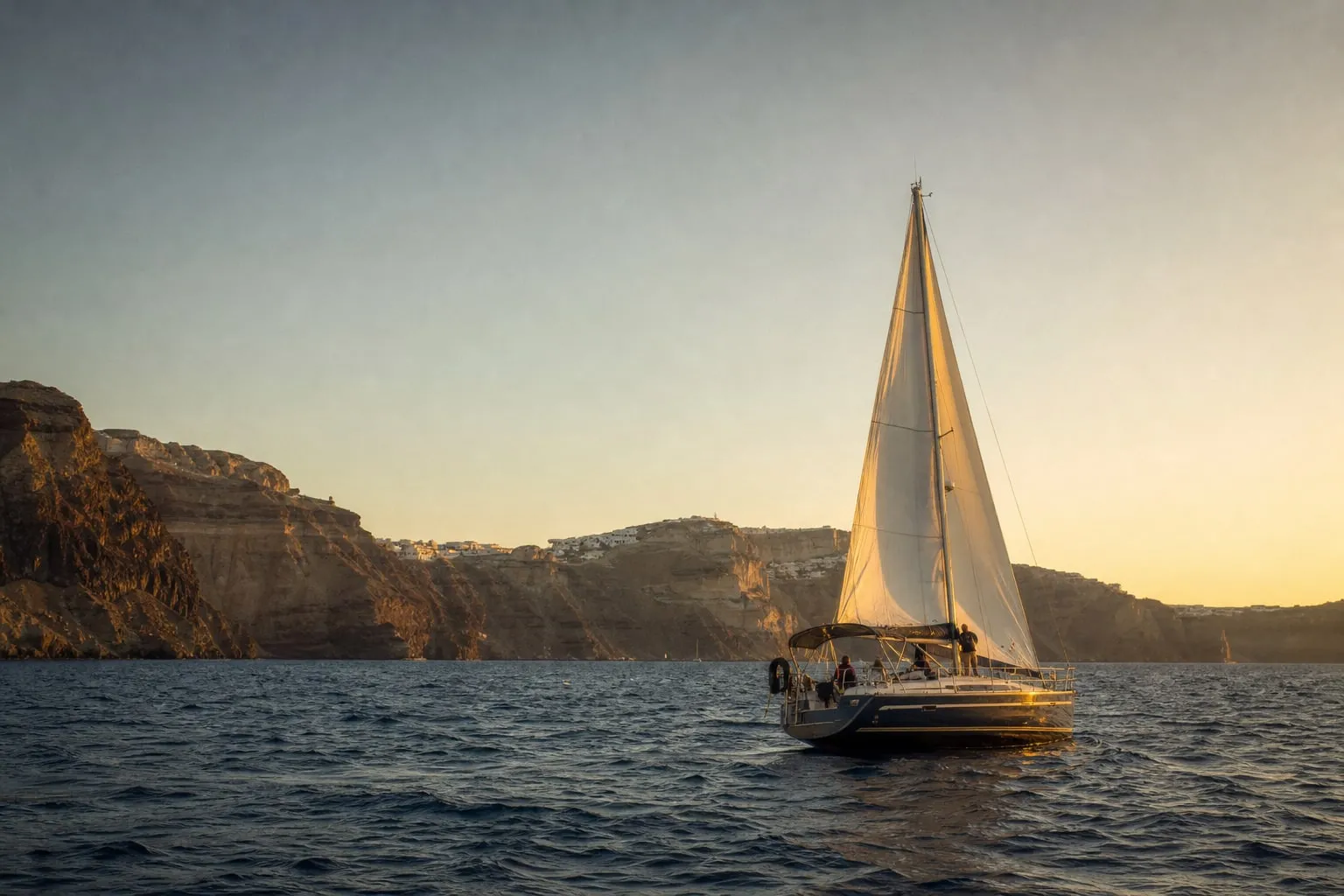
The view from Oia is the edge of one of the largest volcanic eruptions in human history. Around 1600 BCE, the eruption of Thera emptied the magma chamber under the island, and its centre collapsed into the sea, leaving the ring of cliffs that the village now sits on. The islands in the middle of the bay, Nea Kameni and Palea Kameni, are the tops of younger volcanic cones; Nea Kameni last erupted in 1950. On a clear evening you are watching the sun set across a flooded volcano.
Sunset from the water
Boats leave the old port below Fira and Ammoudi Bay for afternoon cruises that stop at the hot springs near Palea Kameni and end with the sunset out on the caldera, looking back at the white villages on the cliffs. From the water, the view is reversed: the cliffs catch the last light and the villages glow above you. In windy weather these trips can be rough or cancelled, so keep a land plan in reserve.
A quieter alternative
For a sunset with fewer people, look east of Oia along the caldera rim towards Imerovigli and Firostefani, or go down to the lighthouse at Akrotiri on the island’s south-western tip. The lighthouse faces open sea to the west and, in autumn, often has only a handful of people at sunset. Bring a torch for the walk back to the car; the path is uneven.
After the sun goes down
Do not leave at the moment of sunset. Civil twilight lasts about 25 minutes at this latitude, and the brightest colours on the cliffs and the water often come in the first ten to fifteen of them, when the sun is a few degrees below the horizon and lights the clouds from underneath.
A sunset that is not in the brochure
Plenty of couples who honeymooned in Santorini, or plan to, mark the place later with a sunset from home. You can pin the castle at Oia, Ammoudi Bay, or any terrace that matters to you, and dedicate the next sunset there with the exact time. The Sunset shows the time before you pay.