
The Taj Mahal by moonlight: night viewing and full moon dates
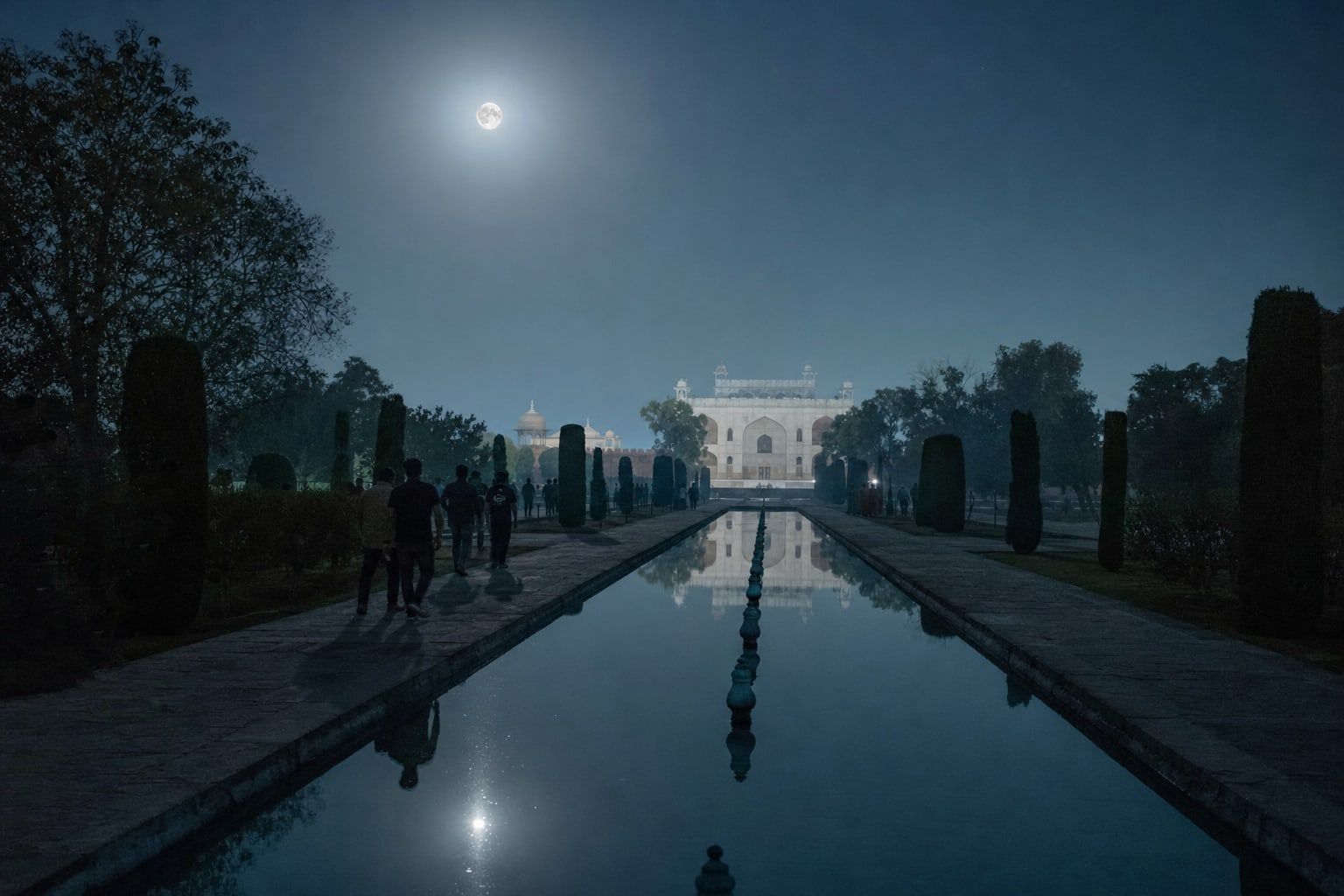
The Taj Mahal in Agra is usually seen in daylight, white marble against the sky. A smaller number of visitors see it by moonlight. The Archaeological Survey of India, which manages the monument, has run night viewing sessions around the full moon for years, and they remain one of the most sought-after tickets in India.
How night viewing works
Night viewing is typically offered on the night of the full moon and on the two nights before and after it, five nights in each lunar cycle. Visitors enter in small groups for half-hour slots, view the mausoleum from a platform at a distance rather than walking up to it, and must book in advance with identification. The monument is closed on Fridays, so there is no night viewing on a Friday, and sessions are suspended during the month of Ramadan.
Rules, slot times and booking arrangements have changed several times; check the ASI’s current information before planning a trip around it.
October 2026
The full moon falls at 04:11 UTC on 26 October 2026, which is 09:41 India Standard Time on 26 October. In Agra the sun sets on 25 October at about 17:40 and rises the next morning at about 06:23. The middle of that night, around midnight, is under ten hours before the moment of full moon, much closer than the middle of the following night. By Resthe’s rule, the full moon night in Agra is 25 to 26 October.
What the marble does
Moonlight is sunlight reflected by the moon, so it has almost the same colour. The eye sees it as cool and bluish because, in dim light, vision shifts to the rod cells, which are more sensitive to blue-green. On white marble that effect is strong: the Taj looks silver-blue, softer than in daylight and without the warm tones of sunset. On a clear night the dome is visible from far across the garden.
Without a ticket
Night viewing slots are limited, and the haze common in northern India in late autumn and winter can soften the moon. Some visitors watch the moon rise over the Taj from Mehtab Bagh, the garden on the opposite bank of the Yamuna, which is aligned with the mausoleum.
The moon over Agra through the season
Where the moon stands in the sky over the Taj depends strongly on the season. A full moon is opposite the sun, so in winter, when the sun is low, the full moon rides high, and in summer it stays low in the south. Calculated for Agra:
| Full moon night | Moonrise | Highest, around | Altitude |
|---|---|---|---|
| 25–26 Oct 2026 | 16:54 | 23:33 | 77° |
| 24–25 Nov 2026 | 16:56 | 00:09 | 89° |
| 23–24 Dec 2026 | 16:37 | 23:58 | 90° |
| 20–21 Feb 2027 | 17:40 | 00:20 | 74° |
| 20–21 May 2027 | 19:11 | 00:26 | 37° |
| 18–19 Jun 2027 | 18:56 | 00:05 | 35° |
Times are India Standard Time. In November and December the full moon passes almost straight overhead around midnight, so from the garden it is high above the dome rather than beside it; the best compositions with the moon near the minarets come in the early evening, an hour or two after moonrise, when it is still low in the east. In May and June the moon crosses the southern sky at only about 35 degrees, and at midnight it hangs behind the viewer in the garden, but from Mehtab Bagh on the far bank, looking south across the river, it stands above the mausoleum.
The full moon in November and December
After October, the next full moons fall at 14:53 UTC on 24 November 2026, which is 20:23 in India, and at 01:28 UTC on 24 December, 06:58 in India. In Agra the first falls in the evening of the 24th, so the full moon night is 24 to 25 November; the second falls just after dawn on the 24th, so the night whose middle is nearest to it is 23 to 24 December. Both are clear-sky months in principle, but they are also the heart of the haze and fog season in the Indo-Gangetic plain, when the moon can look orange and dim near the horizon even on a night without cloud.
Seasons and conditions
Agra has three practical seasons for a visit. From October to March the days are pleasant and the nights cool, sometimes close to freezing in January, with fog most likely from mid-December to January. From April to June the heat is intense, often above 40 °C in the afternoon, and dust can veil the sky. The monsoon, roughly July to September, brings cloud and heavy rain, so full moon nights are often hidden. Late October, February and early March combine clearer nights with comfortable temperatures.
The building in the dark
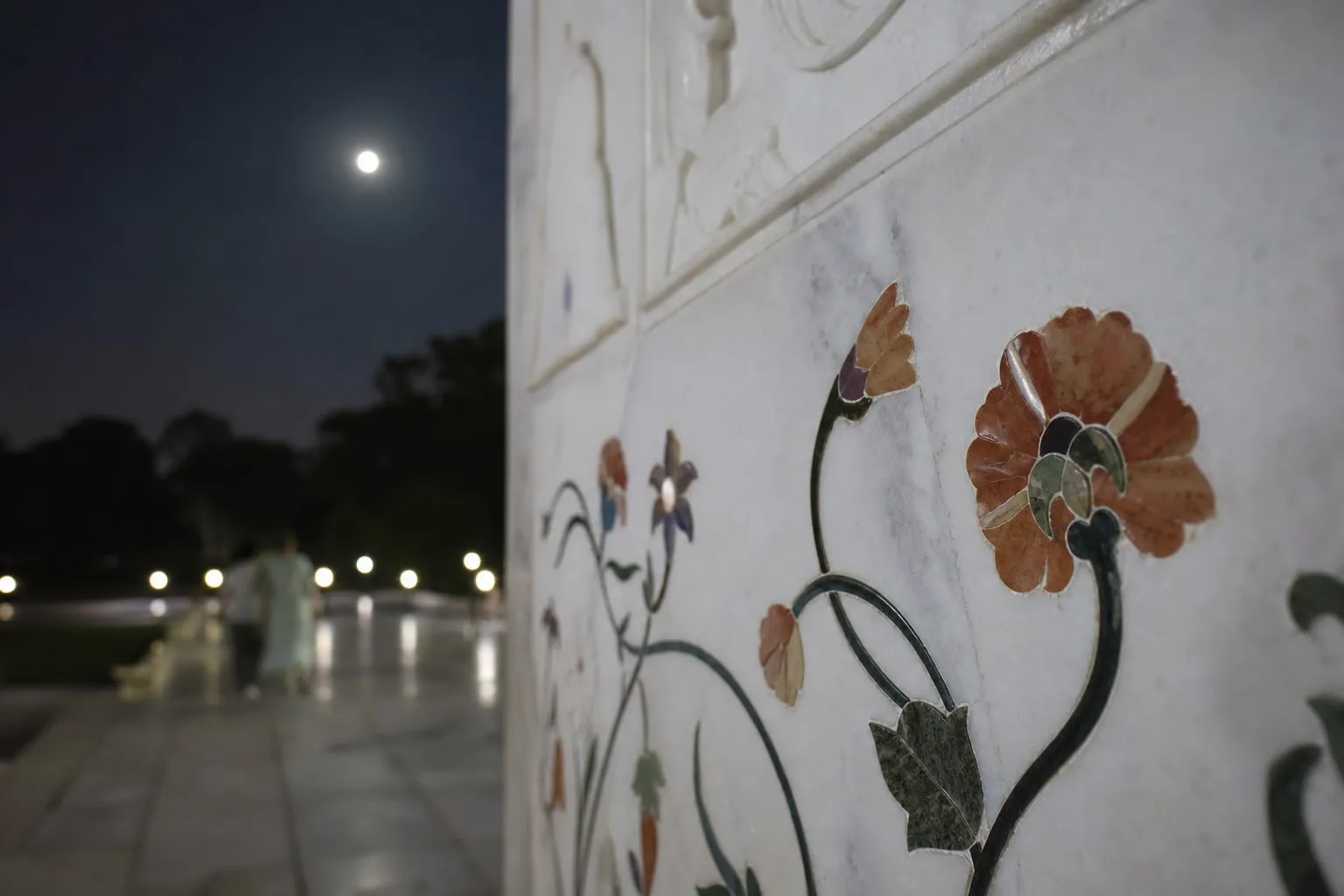
The marble of the Taj Mahal is not pure white: it has a faint warm tint and translucency that pick up any colour in the light. By day it can look pink at dawn, white at noon and golden at sunset. By moonlight the colour drains away and the contrast between the dome and the darker red sandstone of the gateway and the mosque grows stronger. Inlaid stones in the marble, the pietra dura flowers of the façade, are too small to see from the night viewing platform, but the outline of the dome and the four minarets stands out clearly against the sky.
A full moon night over the Taj
For a couple who visited Agra, or plan to marry or honeymoon in India, a full moon night over the Taj Mahal is a moment with obvious meaning. You can pin the monument and see which night the next full moon falls on with The Full Moon Night; for a wedding, Our First Full Moon Night finds the first full moon night on or after the date.