
What a supermoon is, and how much bigger it really looks
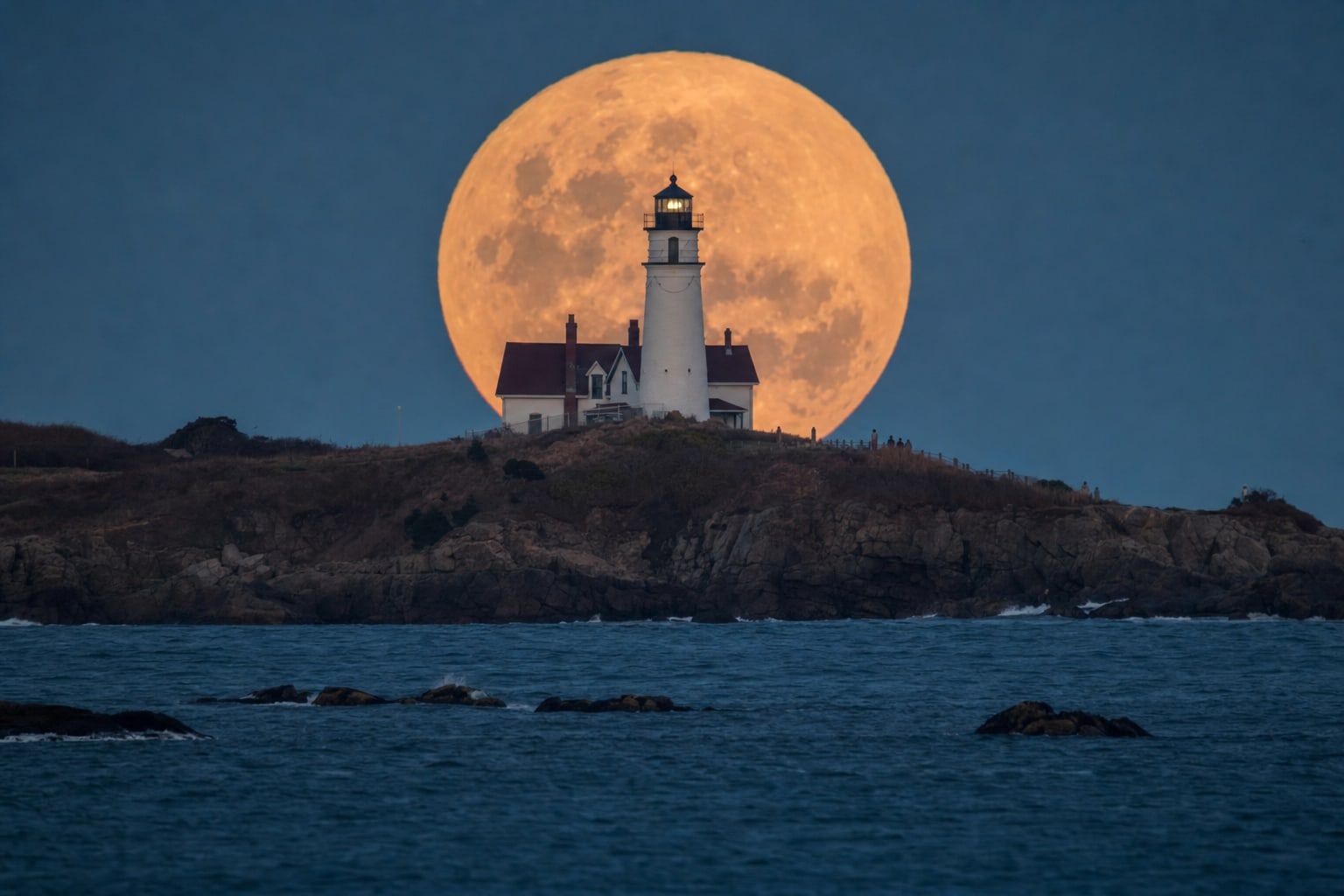
Few astronomy headlines travel as fast as “supermoon tonight”. The term is not an old one: it was coined by the astrologer Richard Nolle in 1979, and astronomers adopted it only loosely. Behind the marketing there is a real, measurable effect, though a smaller one than the photographs suggest.
The moon’s distance changes
The moon’s orbit is an ellipse. Its distance from Earth varies over each orbit between roughly 356,500 km at the closest point, perigee, and about 406,700 km at the farthest, apogee. The exact values change from month to month because the sun’s gravity stretches and twists the orbit.
A supermoon is a full moon that happens close to perigee. There is no single official threshold; a common working definition is a full moon within about 90% of the closest approach in that orbit. The opposite, a full moon near apogee, is sometimes called a micromoon.
How much difference it makes
Comparing the two extremes:
- the moon’s apparent diameter is up to about 14% larger at perigee than at apogee;
- the full moon is up to about 30% brighter, because brightness depends on the apparent area of the disc.
Those numbers compare the very largest full moon with the very smallest, which happen months apart. Compared with an average full moon, a supermoon is only around 7% larger. Most people cannot tell the difference by eye without a side-by-side photograph.
Why the photos look dramatic
The famous images of a huge moon behind a lighthouse or a skyline are taken with long telephoto lenses from far away. The lens magnifies the moon and the foreground together, making the moon look enormous relative to the building. Any full moon, super or not, looks like that through a 600 mm lens.
The other ingredient is the moon illusion: the moon low on the horizon looks larger to the eye than the same moon high in the sky. It is not optical; the image on your retina is the same size. The brain simply judges objects near the horizon as bigger.
Effects on Earth
The moon’s gravity drives the tides. When a full or new moon coincides with perigee, the tidal range is somewhat larger than usual, the so-called perigean spring tides. The effect is measurable, often a few centimetres to tens of centimetres depending on the coast, and matters for low-lying places when combined with storms.
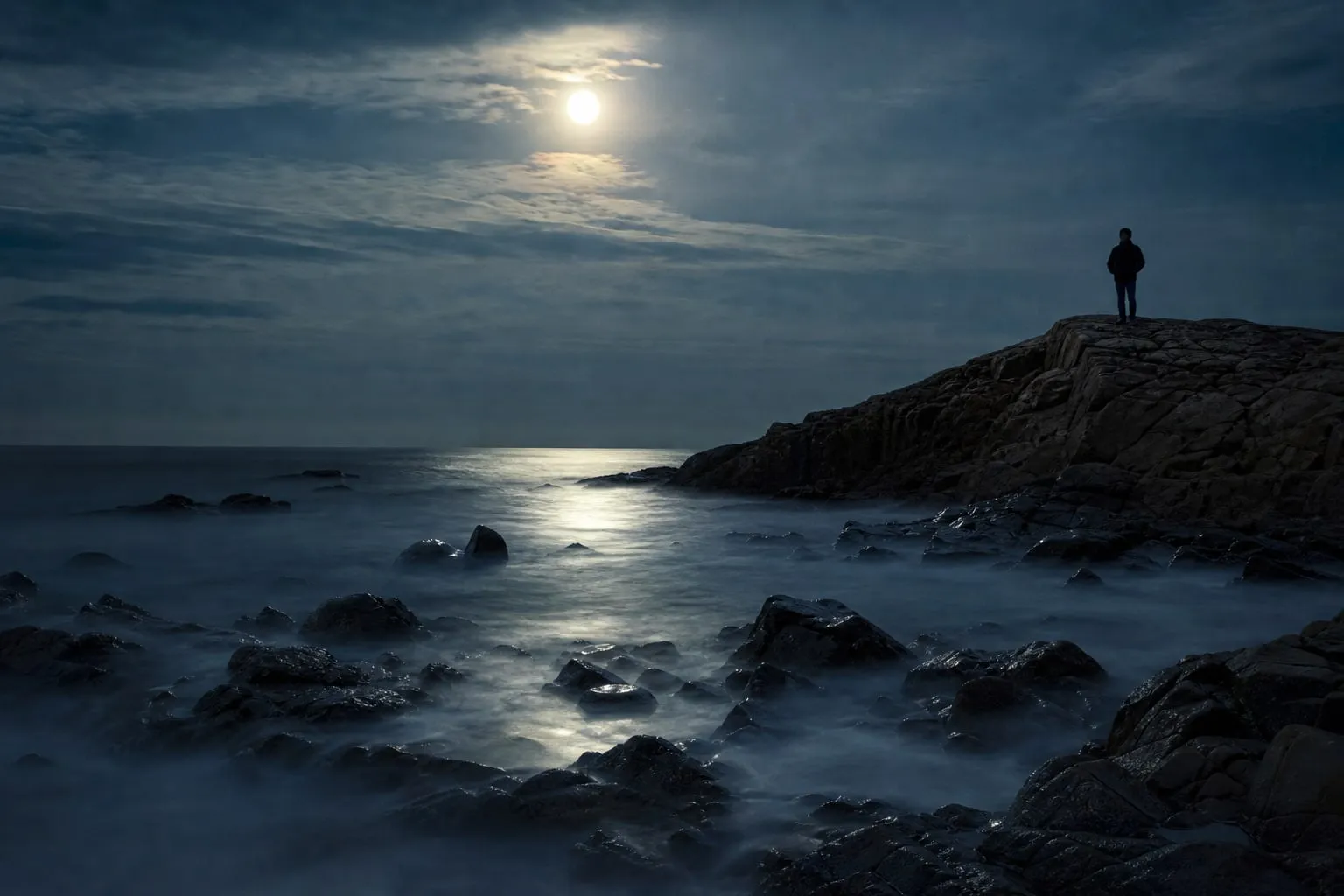
The full moons of the coming year, by distance
Calculated for each full moon from October 2026 to January 2028, the distance between the centres of the Earth and the moon, and the moon’s apparent diameter:
| Full moon (UTC date) | Distance | Apparent diameter |
|---|---|---|
| 26 Oct 2026 | 368,859 km | 32.4′ |
| 24 Nov 2026 | 360,754 km | 33.1′ |
| 24 Dec 2026 | 356,729 km | 33.5′ |
| 22 Jan 2027 | 357,635 km | 33.4′ |
| 20 Feb 2027 | 363,296 km | 32.9′ |
| 20 May 2027 | 393,893 km | 30.3′ |
| 18 Jul 2027 | 405,968 km | 29.4′ |
| 13 Dec 2027 | 368,131 km | 32.4′ |
| 12 Jan 2028 | 360,257 km | 33.2′ |
The Christmas Eve full moon of 2026 is the closest of the period: the moon reaches perigee, at 356,641 kilometres, only about seven hours after the moment of full moon. By any definition it is a supermoon, and the January 2027 full moon is almost as close. Seven months later, the full moon of 18 July 2027 is near apogee, a micromoon. Their apparent diameters, 33.5 and 29.4 minutes of arc, differ by about 14 percent, and the area of the disc, which governs brightness, by about 30 percent: the textbook extremes, both within one year.
Why supermoons come in runs
The point of the moon’s orbit closest to the Earth slowly turns, completing a circuit in about 8.85 years, while full moons recur every 29.5 days. For a few months each year, the full moons fall near perigee; about seven months later, they fall near apogee. That is why supermoons arrive in groups of two to four consecutive months, as in November 2026 to January 2027, and why the following summer has small full moons. The cycle drifts by roughly six weeks a year, so the season of supermoons moves through the calendar over the years.
A test you can do
The difference is real but easy to miss. To see it, photograph the full moon in December 2026 and again in July 2027 with the same lens and the same camera settings, and compare the two images at the same scale. The December moon will be visibly wider. The eye alone, comparing memories seven months apart, is not a reliable instrument; the camera is. A full moon rising over the same landmark in both months makes the comparison even clearer.
Watching one
Treat a supermoon as a good reason to look up rather than a special phenomenon. Watch it rise around sunset, when it is low, coloured and, thanks to the illusion, impressive.
Every full moon has a precise moment and a night at each place. A Resthe certificate records the moment of full moon and the moon’s illumination, whatever its distance. You can see the next one for any point with The Full Moon Night.