
White nights in Saint Petersburg: when twilight lasts all night
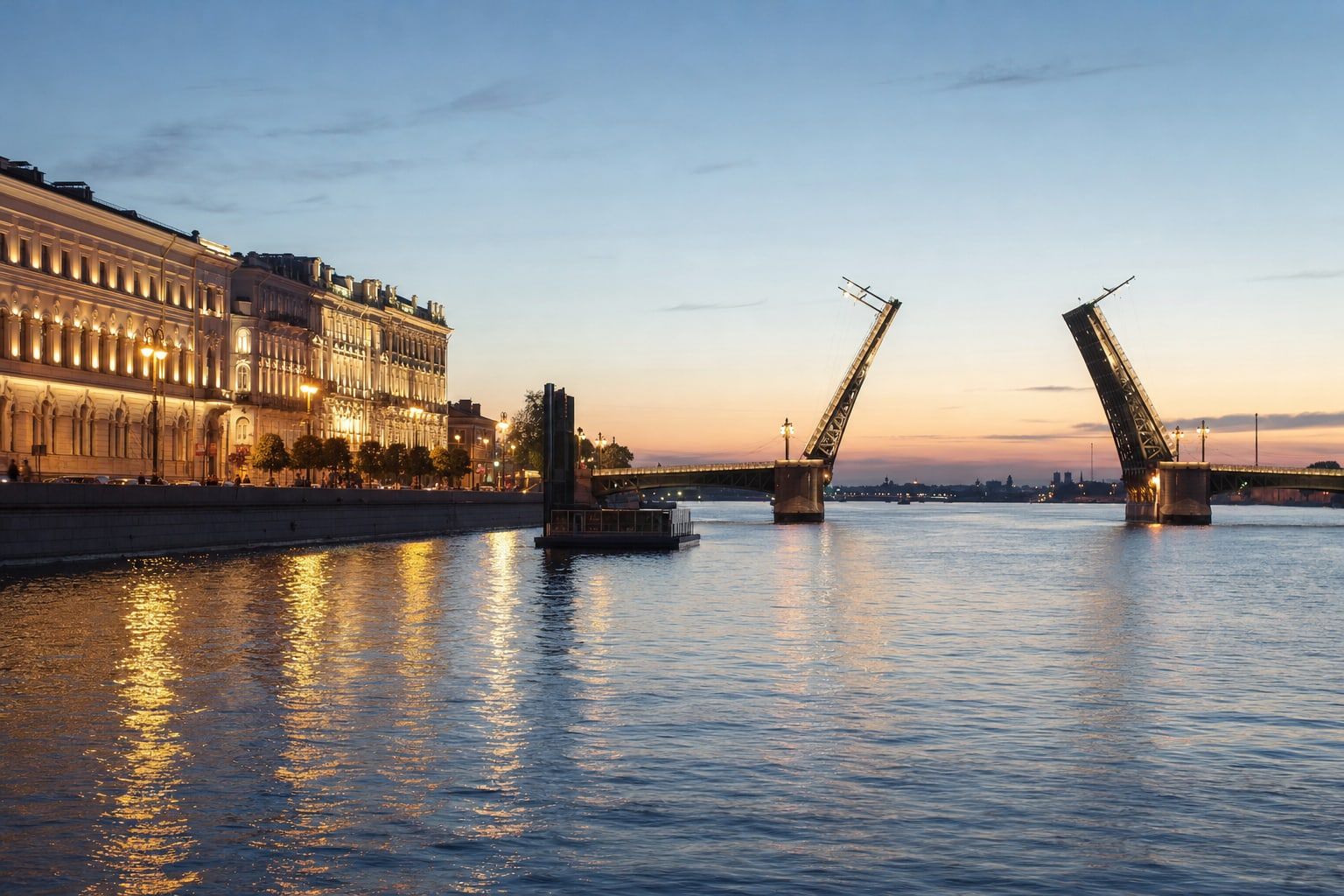
Saint Petersburg lies at almost 60° north, the most northern city in the world with more than a million people. That latitude gives it the season the city is famous for: the white nights, when the sun goes down late, comes up early, and the sky between never turns fully dark.
The numbers
Calculated with the standard rule for the city centre, at the June solstice 2027 the sun sets at about 22:25 and rises at about 03:35 Moscow time. The sun is below the horizon for only about five hours.
More importantly, it never sinks far below it. At 60° north on the solstice, the sun reaches its lowest point at only about 6.5° below the horizon around 1 a.m. local solar time. Six degrees is the boundary of civil twilight, which means that for weeks around midsummer the city passes the whole night in civil or bright nautical twilight. Streets are readable, the Neva shines silver, and the bridges raised for night shipping stand against a pale sky.
The white nights are usually counted from late May to mid-July, though the exact start and end depend on how dark one decides “dark” is.
How long the white nights last
Defined strictly, as the period when the sun never goes more than 12° below the horizon so that the night never leaves nautical twilight, the white nights in 2027 run from about 12 May to 31 July, roughly eighty nights. Around the solstice itself the sun’s lowest point is only about 6.6° below the horizon, so the darkest part of the night is a luminous blue in which streetlights seem almost unnecessary.
People in Saint Petersburg often count the season more narrowly, from late May to mid-July, when the nights are at their brightest. Either way, the change is gradual: there is no single night when the white nights begin, only a slow brightening of the small hours through May.
The bridges
Saint Petersburg is built on islands in the Neva delta, and its main bridges open at night to let ships pass between the Baltic and the inland waterways. During the navigation season the drawbridges are raised in the small hours on a published schedule. Watching the Palace Bridge rise against the pale sky, usually some time after 1 a.m., is one of the city’s classic summer sights, and a practical warning: anyone on the wrong side of the river when the bridges open has a long wait.
Winter is the mirror image
Six months later, the same latitude gives a short day. At the December solstice 2026, the sun rises at about 09:59 and sets at about 15:53, under six hours of daylight. The sun crawls low along the southern horizon, and the long twilight that makes summer nights white makes winter afternoons blue.
Why other cities do not get the same nights
Twilight depends on how far below the horizon the sun goes at midnight. At the solstice that depth is 90° minus your latitude minus 23.4° (the Earth’s axial tilt), in degrees:
- Saint Petersburg, 60° N: about 6.5°, civil-to-nautical twilight all night.
- Stockholm, 59.3° N and Oslo, 59.9° N: very similar, with their own summer light.
- Paris, 48.9° N: about 17.7°, just short of full astronomical darkness, so nights are noticeably darker.
- Reykjavik, 64.1° N: the sun goes only a couple of degrees below the horizon; at the 2027 solstice it sets just after midnight and rises before 3 a.m.
In books and music
The white nights have been part of the city’s culture almost since it was founded. Pushkin described the transparent twilight of the northern capital in the introduction to The Bronze Horseman, and Dostoevsky set his short story White Nights (1848) over four sleepless nights of a lonely young man walking the embankments. Both are still read as portraits of the city in June: restless, luminous, a little unreal.
Practical notes for a visit
- Book early. Late June is the city’s busiest and most expensive season.
- Bring an eye mask. Hotel curtains vary, and the sky outside is bright at 2 a.m.
- Plan around the bridges. Check the opening schedule for the bridge you need before a late dinner on the other side of the Neva.
- Go out after midnight. The embankments, the Palace Square and the Summer Garden are busy and safe in the small hours, and the light is at its strangest then.
Further north, further south
The same latitude runs through other cities with their own versions of the season. Helsinki, Tallinn, Stockholm and Oslo all lie close to 60° north and share bright June nights, each with its own midsummer customs, from bonfires on the Finnish coast to midsummer poles in Sweden. Further south, the effect fades quickly: in Berlin or Warsaw the June nights are short and never fully dark, but the sky does turn a deep blue at midnight.
Seeing them
The city marks the season with the Scarlet Sails celebration for school graduates, usually held in late June, and with bridges opening on schedule through the night. Late June brings the brightest nights; by mid-July they begin to darken again.
A summer sunset over the Neva, or a sunrise a few hours later, can be dedicated to someone with the exact time for the point you choose. The Sunset and The Sunrise show the time before you pay.