
Why the setting sun looks flattened and oval
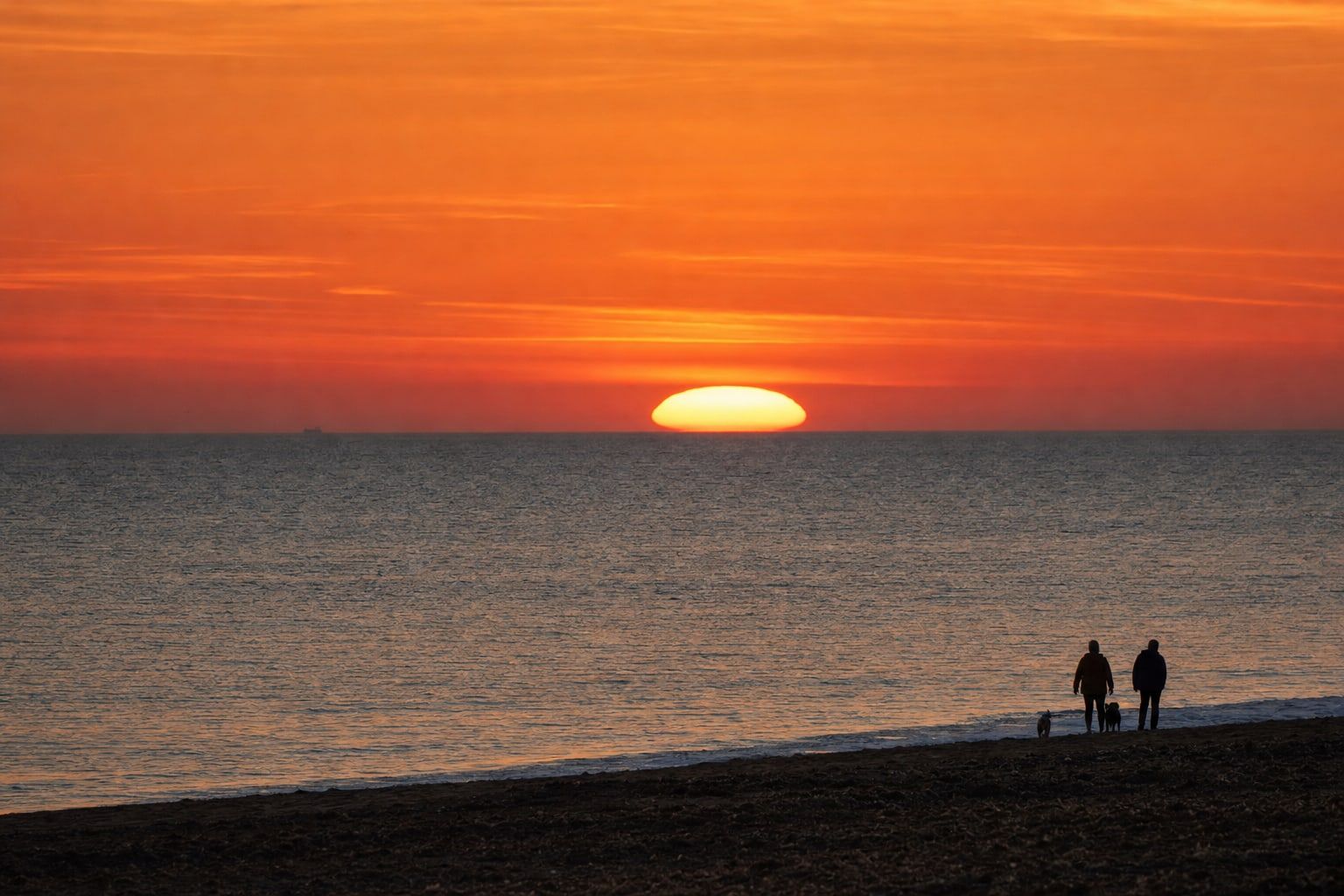
Watch a sunset over the sea on a clear evening and you will often see the sun lose its round shape as it nears the horizon. It becomes an oval, wider than it is tall. On some evenings it breaks into stacked layers, or takes on corners and looks almost like a lantern. None of this is the sun changing. It is the air between you and it.
Refraction is stronger lower down
Light bends when it passes from thinner to denser air. Near the zenith the effect is tiny; near the horizon, where light crosses the full thickness of the lower atmosphere at a grazing angle, it is large. At the horizon, refraction lifts the image of a star or the sun by about 34 arcminutes, while at an altitude of half a degree it lifts it by only about 29.
The sun’s disc spans about half a degree. Its lower edge, closer to the horizon, is lifted more than its upper edge. The bottom of the disc is pushed up toward the top, and the sun looks flattened, typically by around a fifth of its height when its lower edge touches the horizon.
Layers and odd shapes
The standard figure assumes that air temperature falls smoothly with height. Over a cold sea, or above warm ground in the evening, it often does not. A layer of warm air over cold air (a temperature inversion) bends light unevenly at different heights, and the image of the sun splits into bands, steps or a mushroom shape. The famous “Etruscan vase” and “Omega sunset” over the sea are both inversion effects.
The same conditions sometimes produce the green flash: in the last second before the sun disappears, the topmost sliver turns green, because the atmosphere bends green light slightly more than red.
Two extra minutes of daylight
Refraction does more than reshape the sun. Because it lifts the image by more than the sun’s own width, you see the whole disc above the horizon at a moment when the real sun has already set. At mid-latitudes this adds roughly two minutes of visible daylight at each end of the day, and more near the poles where the sun moves at a shallow angle.
That is why the standard definition of sunrise and sunset puts the sun’s centre 0.833° below the horizon: about 0.27° for half the disc plus about 0.57° for average refraction. Unusual air can move the visible sunrise or sunset by a minute or more either way; the calculated time stays fixed.
The moon does it too
Everything said here about the sun applies to the rising or setting full moon, which is about the same apparent size. A moon just above the sea horizon is visibly oval, and on cold evenings over water it can split into the same layered shapes as the sun. Because the moon is far dimmer, these shapes are much easier and safer to watch, with binoculars if you like, and they are a good way to see refraction at work.
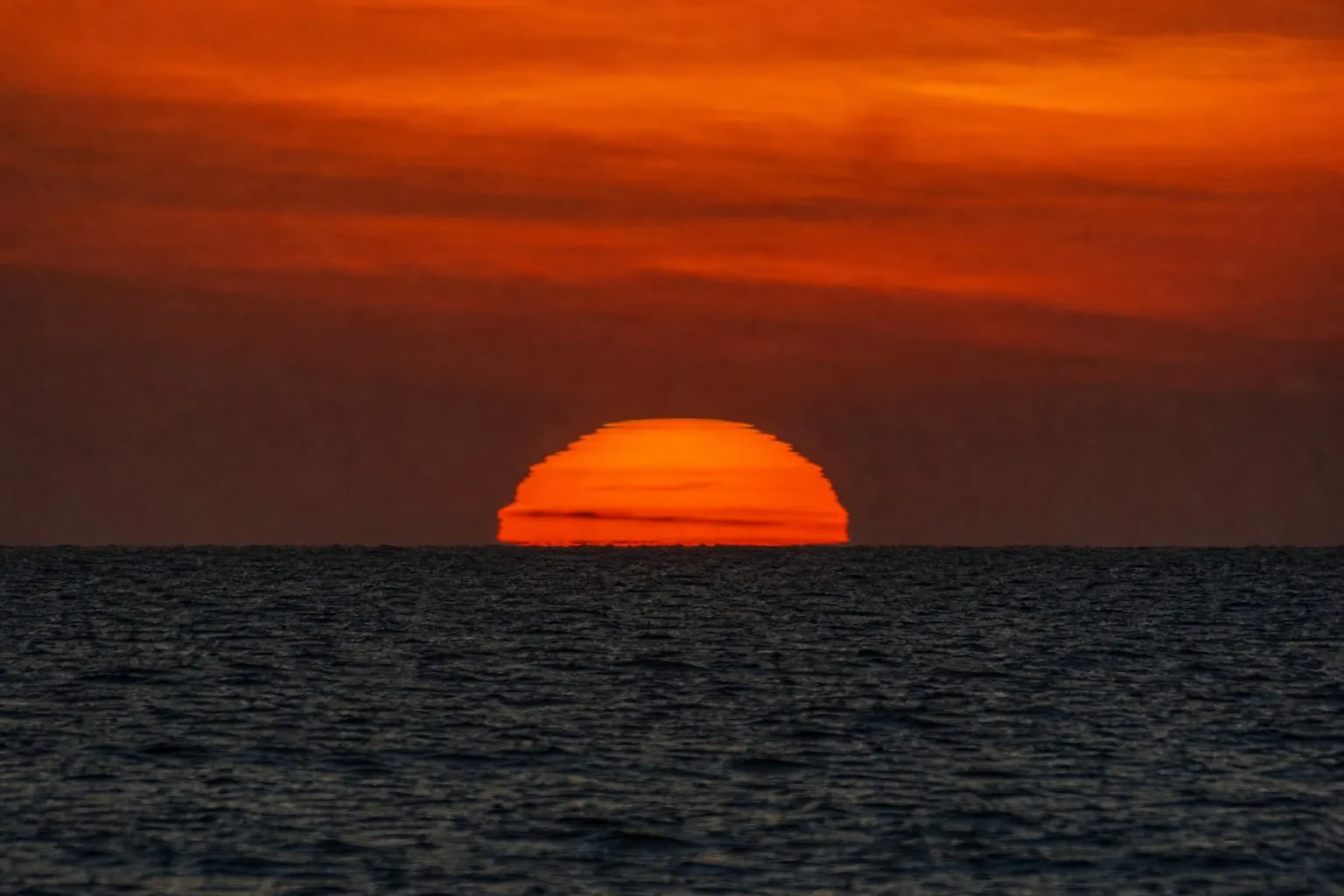
Why the sun looks red when it is flat
Refraction and colour come from different effects that happen to peak at the same moment. Refraction bends light; scattering removes it. Near the horizon, sunlight crosses up to about forty times more air than when the sun is overhead, and the molecules of the air scatter blue light out of the beam far more than red. What reaches you is mostly orange and red. So the sun at the horizon is at once flattened by refraction and reddened by scattering, and the two together give the familiar picture of a low, wide, glowing disc.
Mirages at sea level
A related effect, the inferior mirage, often shows at sunset over warm water or hot ground. Air heated from below bends light upward, producing an inverted image of the sun just under the real one. As the sun sinks, the two meet at the horizon and briefly form a shape like the Greek letter omega, Ω. Watching an omega sunset from a beach is one of the easiest ways to see a mirage with your own eyes.
How the shape changes in the last minutes
If you watch a full sunset over the sea, the flattening grows as the sun sinks. With the lower edge a few diameters above the horizon, the disc looks almost round. As the lower edge approaches the horizon, the bottom is lifted more and more, and the sun takes on the shape of a slightly squashed egg, flatter below than above. In the last minute, when only the top half remains, the visible part often looks wider than the full disc did a few minutes earlier. All of this happens without any change to the sun itself, only to the path of its light through the last few kilometres of air.
Seeing it yourself
- Pick a low, distant horizon. A sea or a flat plain shows the effects best.
- Never look at a high sun directly. The flattened sun is only safe to glance at when it is very low and dimmed by haze; use a camera screen otherwise.
- Watch the last seconds. Inversions and green flashes are brief.
Every Resthe sunset is calculated with the standard 0.833° rule for the exact point you choose. You can see the time for any coastline with The Sunset.