
Why the full moon rises as the sun sets
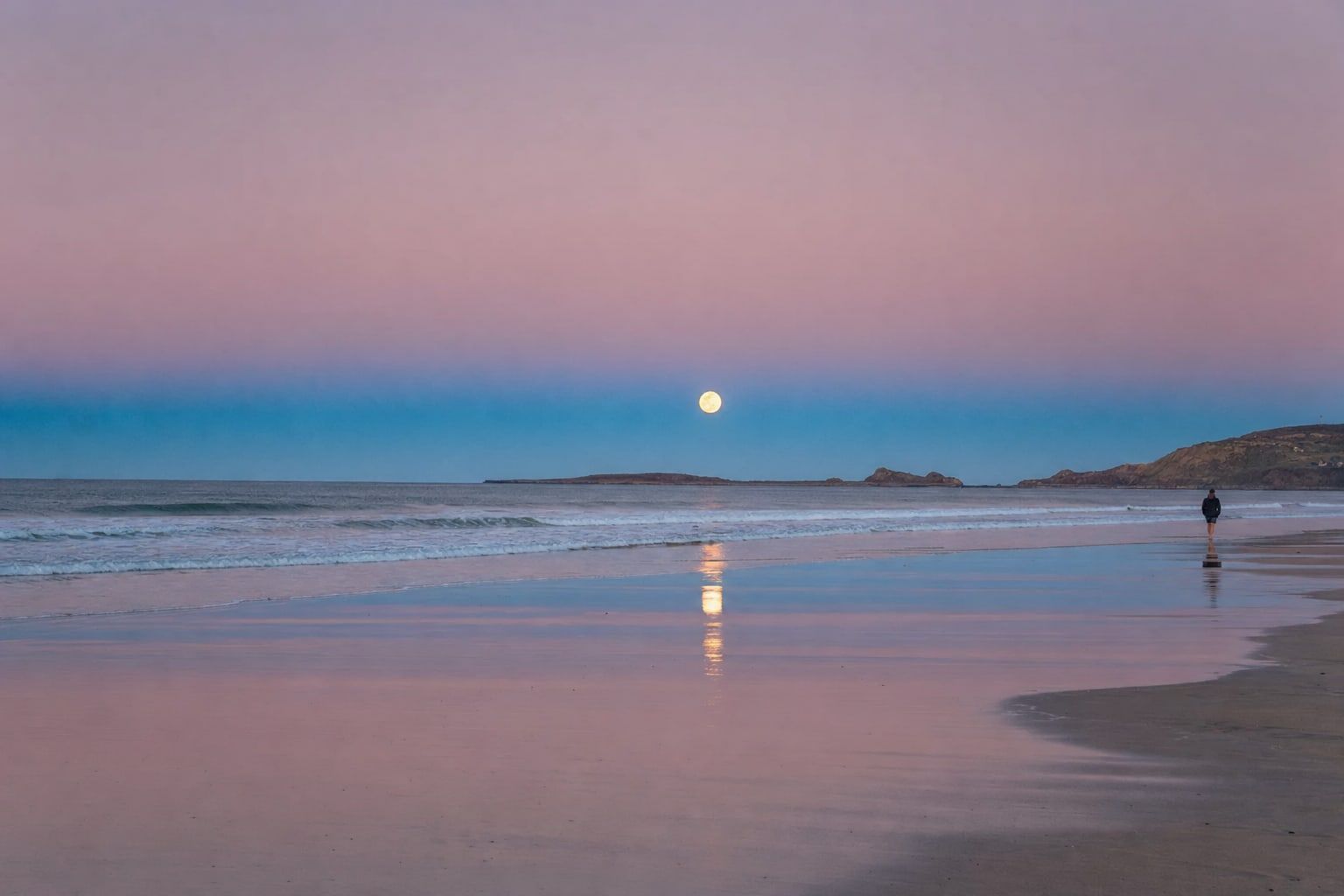
On a clear evening around the full moon you can stand facing west to watch the sunset, then turn round and find the moon rising in the east. The two events are linked by simple geometry, and once you see why, you can predict where to look on any full moon night.
Opposite the sun
A full moon is, by definition, the moment when the moon stands opposite the sun as seen from Earth: its ecliptic longitude is 180° from the sun’s. The sun lights the half of the moon facing it, and at that moment we see that half almost entirely.
Because the moon is opposite the sun, it behaves like a mirror image of the sun’s day. When the sun sets in the west, the moon is about to rise in the east. When the sun is at its lowest, below the horizon at around midnight local solar time, the moon is at its highest. When the sun rises, the full moon sets.
That is also why a full moon is up all night, and why a winter full moon rides high in the sky: it takes roughly the path the summer sun would take.
Never exactly at sunset
Moonrise on the night of the full moon is rarely at the same minute as sunset. Three things separate them:
- The full moon is an instant. On a given evening, the moment of full moon may be twelve hours away. The moon moves about 13° a day relative to the stars, so its rising time shifts noticeably from one night to the next.
- The moon’s orbit is tilted about 5° to the Earth’s orbit. At most full moons the moon is a little north or south of the exact opposite point, which moves its rising time.
- Refraction and the moon’s own size affect moonrise in a slightly different way from sunrise.
So the full moon may rise twenty minutes before sunset on one evening and half an hour after it on another.
The October example
The Hunter’s Moon is full at 04:11 UTC on 26 October 2026. For Europe and the Americas, that moment falls during the night of 25 to 26 October, so on the evening of 25 October the moon rises close to sunset, nearly full. In the weeks around the September equinox, the moon also rises only a little later each evening at mid-northern latitudes, so bright moonlight follows sunset several evenings in a row.
A year of full moon nights in London
The difference between sunset and moonrise on a full moon night changes from month to month. Calculated for central London, for the night that counts as each full moon night (the night whose middle is nearest the moment of full moon):
| Full moon night | Sunset | Moonrise | Moon rises |
|---|---|---|---|
| 25 Oct 2026 | 16:46 | 16:01 | 45 min before |
| 24 Nov 2026 | 16:00 | 15:17 | 43 min before |
| 23 Dec 2026 | 15:54 | 14:48 | 66 min before |
| 22 Jan 2027 | 16:31 | 16:33 | 2 min after |
| 20 Feb 2027 | 17:24 | 17:01 | 23 min before |
| 21 Mar 2027 | 18:14 | 17:24 | 50 min before |
| 20 Apr 2027 | 20:05 | 20:08 | 3 min after |
| 18 Jun 2027 | 21:20 | 21:33 | 13 min after |
| 15 Sep 2027 | 19:15 | 18:46 | 29 min before |
The pattern follows mainly the moment of full moon. When it falls late in the night or the next morning, the moon on that evening is still slightly short of full, so it rises before sunset. When the full moon came earlier the same day, as in January and June, the moon is already a little past full and rises after sunset. The moon’s distance north or south of the sun’s exact opposite point adds or removes some minutes, which is why December shows the largest gap. Over a year, at this latitude, moonrise on the full moon night lands anywhere from about an hour before sunset to a quarter of an hour after it.
The harvest moon effect
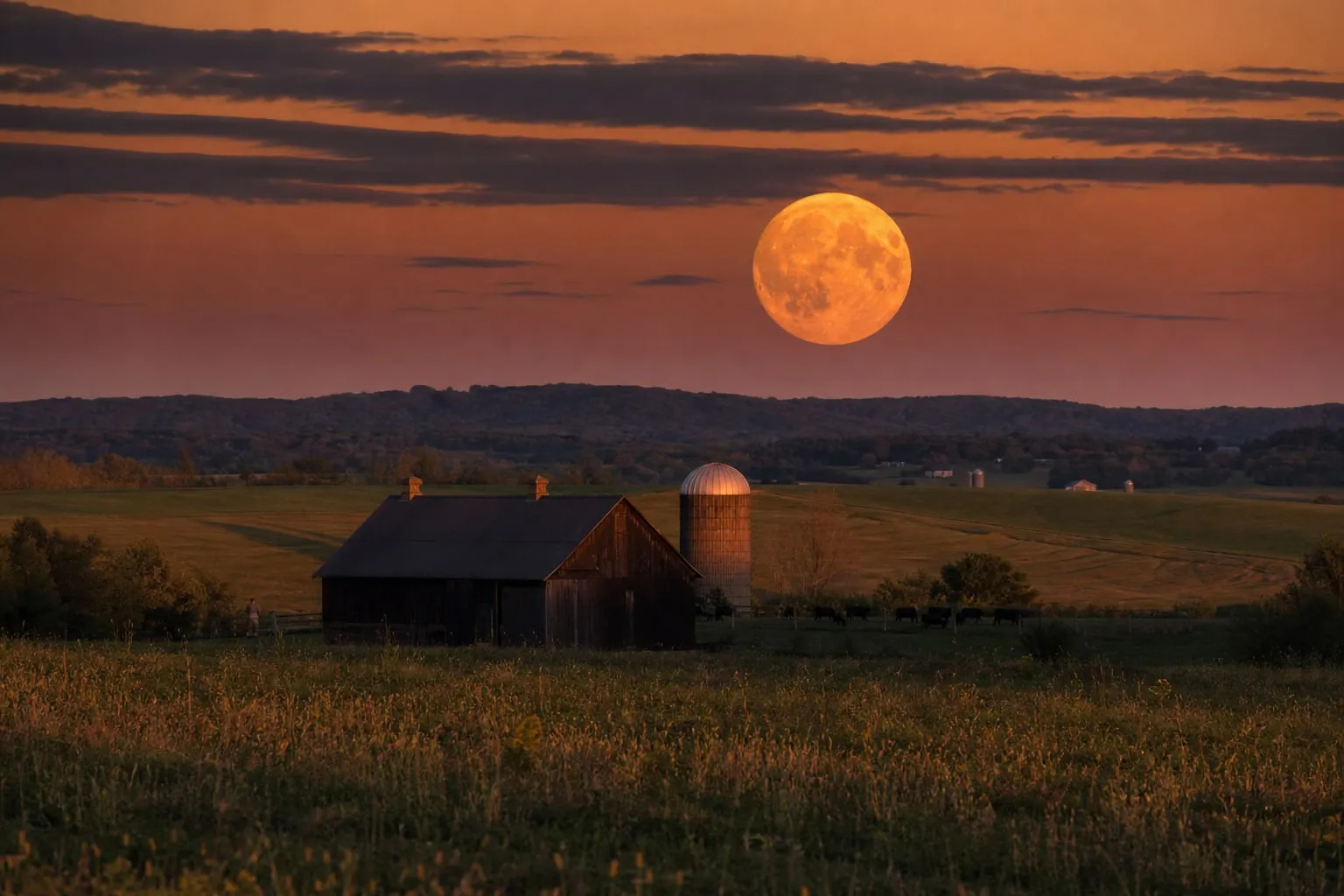
The moon rises later each day, on average by about 50 minutes, because it moves eastward along its orbit by about 13 degrees a day. That average hides a large seasonal swing. Around the September equinox, the moon’s path near the full phase meets the eastern horizon at a shallow angle, and at London in September 2027 the full moon rises only about 12 minutes later from one evening to the next. Around the March equinox the angle is steep, and the delay is about 84 minutes. That is why the full moon nearest the autumn equinox, the harvest moon, seems to linger: for several evenings in a row there is bright moonlight soon after sunset, which once let farmers keep working into the night.
In the southern hemisphere the effect is reversed: the shortest delays come around the March equinox, which is autumn there.
Why the full moon is high in winter
The full moon sits opposite the sun, so it follows roughly the path the sun took six months earlier or later. In December, when the noon sun at London is only about 15 degrees above the horizon, the midnight full moon climbs to about 60 degrees. In June, when the summer sun reaches 62 degrees, the full moon stays low, at around 15 degrees or less, and in some years barely clears rooftops. For anyone photographing the moon over a landscape, early summer gives the low, golden full moons near the horizon; winter gives the bright, high ones that light up snow.
Where it rises
The full moon rises roughly opposite the point where the sun sets: north of east in winter, when the sun sets south of west, and south of east in summer. Facing east at sunset on a full moon evening, the rising moon will usually appear within a few tens of degrees of due east, close to where the sun will rise six months later.
Watching it
- Find an eastern horizon for the moonrise and a western one for the sunset. A hilltop or an open beach gives both.
- Arrive before sunset. The moon is easiest to spot low in the twilight.
- Look for the Earth’s shadow. Just after sunset, a dark blue band rises in the east, with a pink band above it, the Belt of Venus. The full moon often rises inside it.
A full moon night pairs naturally with the sunset that starts it. You can see which night counts as the full moon night at any place with The Full Moon Night, or dedicate the sunset itself with The Sunset.