
The green flash: what it is and where to see it
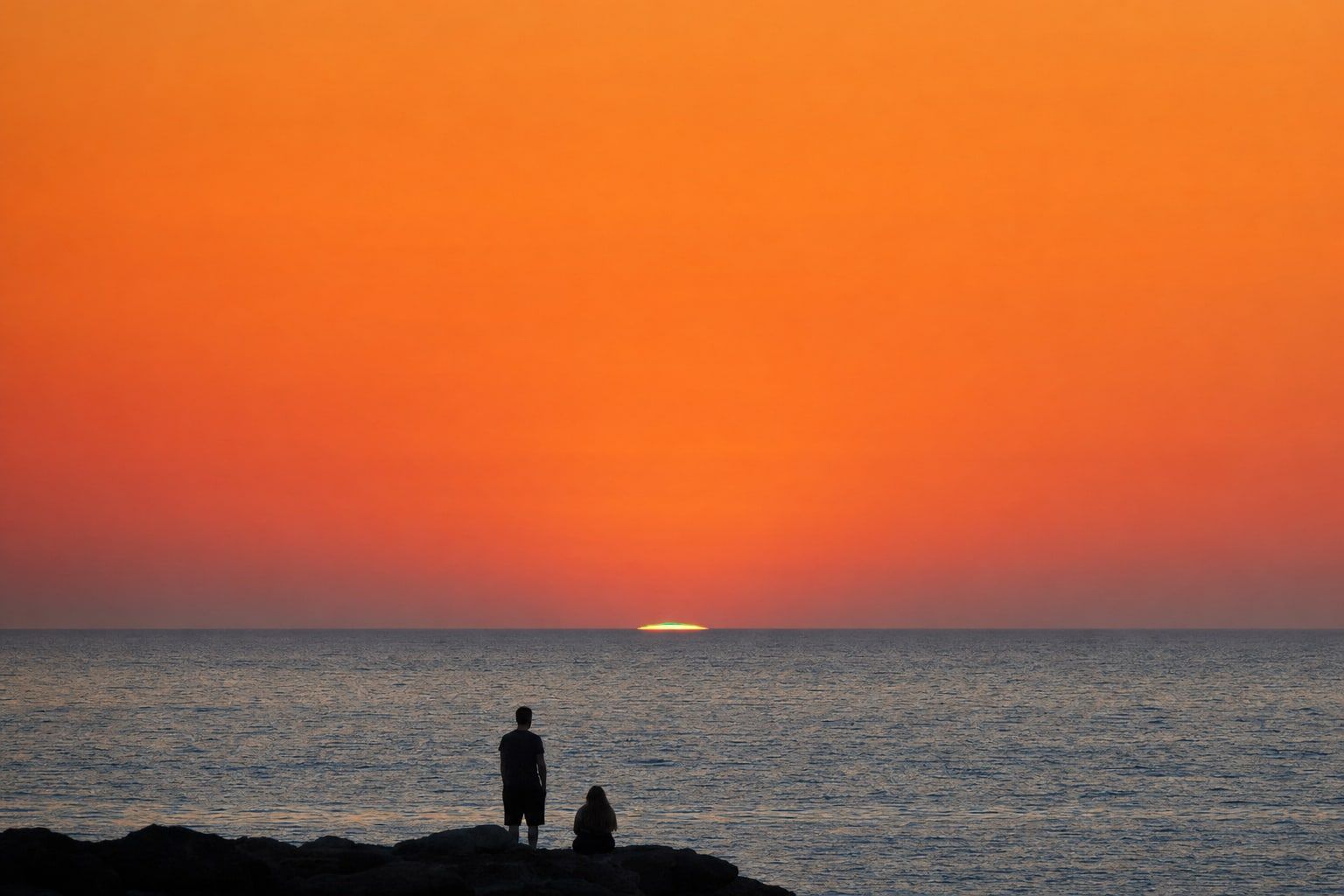
Sailors talk about it, Jules Verne wrote a novel about it, and many people who watch sunsets for years never see it: the green flash, a brief burst of green at the top of the sun at the moment it sets or rises. It is real, it is explained by ordinary physics, and with the right horizon it is not even rare.
Why the last light turns green
The atmosphere acts like a weak prism. It bends light most strongly near the horizon, and it bends shorter wavelengths slightly more than longer ones. As a result, the sun’s image near the horizon is really a stack of slightly offset coloured images: the blue and green ones sit a fraction higher than the red.
Most of the time the difference is too small to see, because the overlapping images blend into white and orange. In the last second or two of a sunset, though, only the topmost sliver of the sun remains above the horizon, and that top edge belongs to the most strongly bent colours. Blue and violet are scattered away by the long path through the air, leaving green as the last colour standing.
At sunrise the order reverses: a green rim can appear for a moment before the rest of the sun.
What it needs
- A distant, sharp horizon. The open sea is ideal. A flat desert or a distant mountain ridge can work.
- Clear, stable air near the horizon. Haze and dust redden and blur the image.
- Often, a temperature inversion. A layer of warm air over cooler air, common over the sea, magnifies the effect and can stretch the flash into a longer “green rim” or a detached green fragment above the setting sun.
Even in good conditions, the classic flash lasts about one to two seconds.
How to improve your chances
- Watch the very end. Keep your eyes off the sun until the last moment. Looking at a bright sun before the end dazzles you, and the green may look like an afterimage.
- Use a camera or binoculars only when the sun is very low and dim. Never point optics at a sun that is still bright.
- Pick high ground over the sea. Seeing the horizon from a cliff or a ship’s deck lengthens the moment slightly.
- Know the time. The calculated sunset tells you when to be watching. The green flash happens within seconds of the moment the sun’s upper edge reaches the horizon.
Refraction: the sun you see is not quite where it is
The same bending of light that separates the colours also lifts the whole image of the sun. At the horizon, standard refraction raises it by about 34 minutes of arc, slightly more than the sun’s own diameter of about 32 minutes. When you watch the lower edge of the sun touch the sea, the real sun is already entirely below the horizon; you are seeing it only because the air bends its light over the curve of the Earth. This is why astronomical sunset is defined by the sun’s upper edge and a refraction of about 0.83 degrees, the convention used in almanacs and in the times we calculate.
Refraction is not constant. It depends on the temperature and pressure of the air near the ground, and above all on how temperature changes with height. Those layers decide not only when the sun disappears but also what the last moments look like: a flattened disc, a stepped outline like a pagoda, a sun that seems to drip into the sea. The green flash belongs to the same family of effects.
How long the last moments last
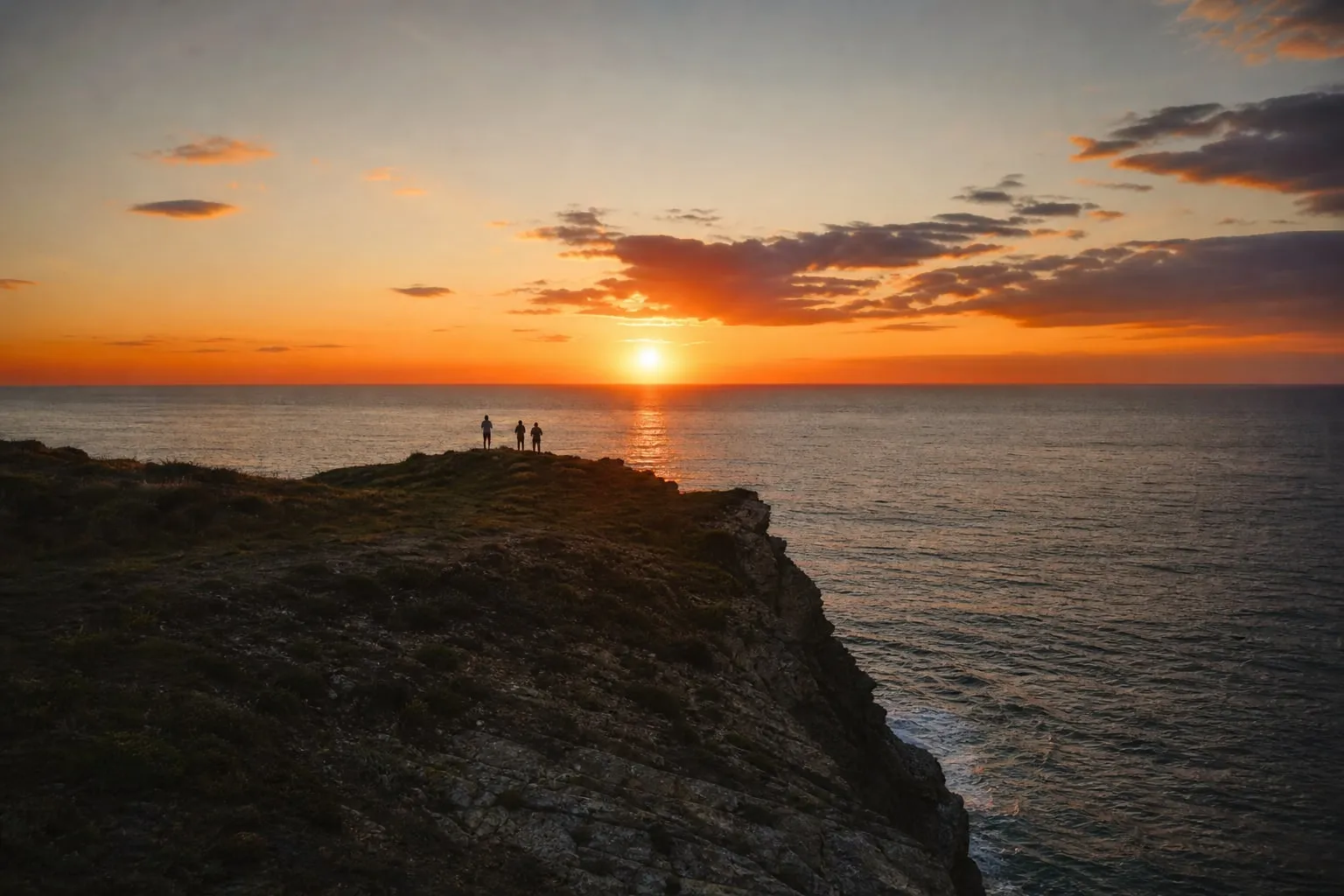
The time the sun takes to sink below the horizon depends on latitude and season, because the sun’s path meets the horizon at a steeper or shallower angle. Calculated for 20 October 2026, the sun’s disc takes about 2.5 minutes to set near the equator at Quito, about 2.8 minutes at Key West and 2.7 minutes at Honolulu, 3.3 minutes at Lisbon, 4.0 minutes at Paris and 6.4 minutes at Reykjavík. In Paris at the June solstice it takes about 5 minutes.
The slower the sunset, the longer the final sliver lingers at the horizon, and the longer a green rim can last. Near the tropics the flash is usually a second or two. At high latitudes, where the sun slides along the horizon, observers have reported green colour lasting far longer; the best-known account comes from the American expedition at Little America in Antarctica in 1929, whose members described the green sun appearing again and again as it skimmed a distant ridge.
The kinds of green flash
Atmospheric optics distinguishes several forms. The most common at sea is the inferior-mirage flash: the warm water heats the air just above it, creating a mirror-like layer, and the top of the sun briefly separates as a small green-tinged lens. A mock-mirage flash appears when a layer of warm air lies above cooler air, often over a cold sea; it produces a thin strip that detaches from the sun and turns green for a second or more. The rare green ray, a beam rising briefly above the horizon after sunset, needs very clear air and a hazy upper layer to show the light. Blue flashes also exist, in exceptionally clean air, but they are rarely seen.
Photographing it
A telephoto lens of 300 millimetres or more, a fast burst rate and an exposure set for the bright edge of the sun are the usual recipe. Frame the sun only when it is low and already dimmed by the long path through the atmosphere, never earlier, and use the screen or an electronic viewfinder rather than an optical one. Photographs are the best answer to the old suspicion that the green flash is only an afterimage: an afterimage of the red sun would be green too, but a camera does not have one.
Where people often see it
Coastlines with a clear western sea horizon: the Atlantic coast of Portugal, the Pacific coast of California and Hawaii, Florida’s Gulf Coast and the Keys, and the western shores of the Greek islands. Ships at sea see it most of all.
The calculated sunset time is the moment to watch for. The Sunset gives it to the minute for any point on a coast, and you can dedicate that sunset to someone who would stand there with you.